
 Some gardeners feel relaxed at this time of the year. There are several reasons for that. People with regular lawn services have had or will have fall clean-up taken care of, with every stray leaf blown away, shrubs pruned, and gardens tidied. Those gangly annuals that looked splendid all summer thanks to in-ground irrigation, have been removed just as they were about to breathe their last gasps. Another group of gardeners with more time, but less paid help, have spent weekend hours doing the leaf removal and tidying. Their gardens don’t look quite as pristine, but there is a semblance of order.
I am in the third camp, with less time and even less paid help. To make matters worse, recovery from a necessary minor medical procedure means that I will be in a situation where I won’t be able to do much, if any, garden work for the next couple of weeks. I write that as I look out on the trembling yellow leaves of the silver bell tree, which are preparing to fall en masse during my absence from the garden.
It would be easy to give up hope, especially when I imagine the local dog walkers, school children and neighbors wading through ankle-deep leaves.
But gardeners live on faith, so I am trying to figure what I might be able to do and how to deal with the rest. After all, gardening is not about what you can’t do in your particular circumstances, but what you can do.
Last year, just after I had raked and mulched the last of the fall leaves, the cordless electric leaf blower that I ordered arrived on my doorstep. I am fairly sure that getting it out of the shipping box—where it has lived since it arrived—will not constitute heavy labor, so I may be able to get it up and fully charged fairly soon. Blowing leaves off the sidewalk is a lot easier than raking them, and I can blow them to a pile in the corner of the yard where they will keep until I can spread and mulch them with the mower.
All my bulbs have arrived, and I am hopeful that the ground will not freeze hard before I can plant them. Over the last few years, hard frosts have not happened routinely until closer to the holidays, so I may have a chance. If not, I can plant them in pots, using the lasagna method of layering smaller bulbs atop bigger ones. They can sit in a corner of my back porch until spring rolls around and then go out in the garden, protected by regular applications of deer spray.
Many of the house plants have made the transition to indoor life, but some still wait outside. If the weather doesn’t get too cold, they may survive. If the cold swoops in, I can take cuttings from most of them. Rooting cuttings in small pots is not strenuous, unless I must heft up a twenty-pound sack of potting soil. I will make sure that does not happen.
Lawn mowing and hedge trimming will have to wait two or three weeks, but thankfully growth is slower at this time of year. Heavy pruning will also be on hold until I am once again fit to wield the loppers and pruning saw with strength, vigor, and authority. All of those chores will still be necessary in a few weeks’ time. The only real danger is that the ever-productive roses of Sharon will cast seeds all over the garden because I will not be able to prune away the seedheads in time. I will pay for my enforced tardiness by grubbing them up all of next spring, summer and fall.
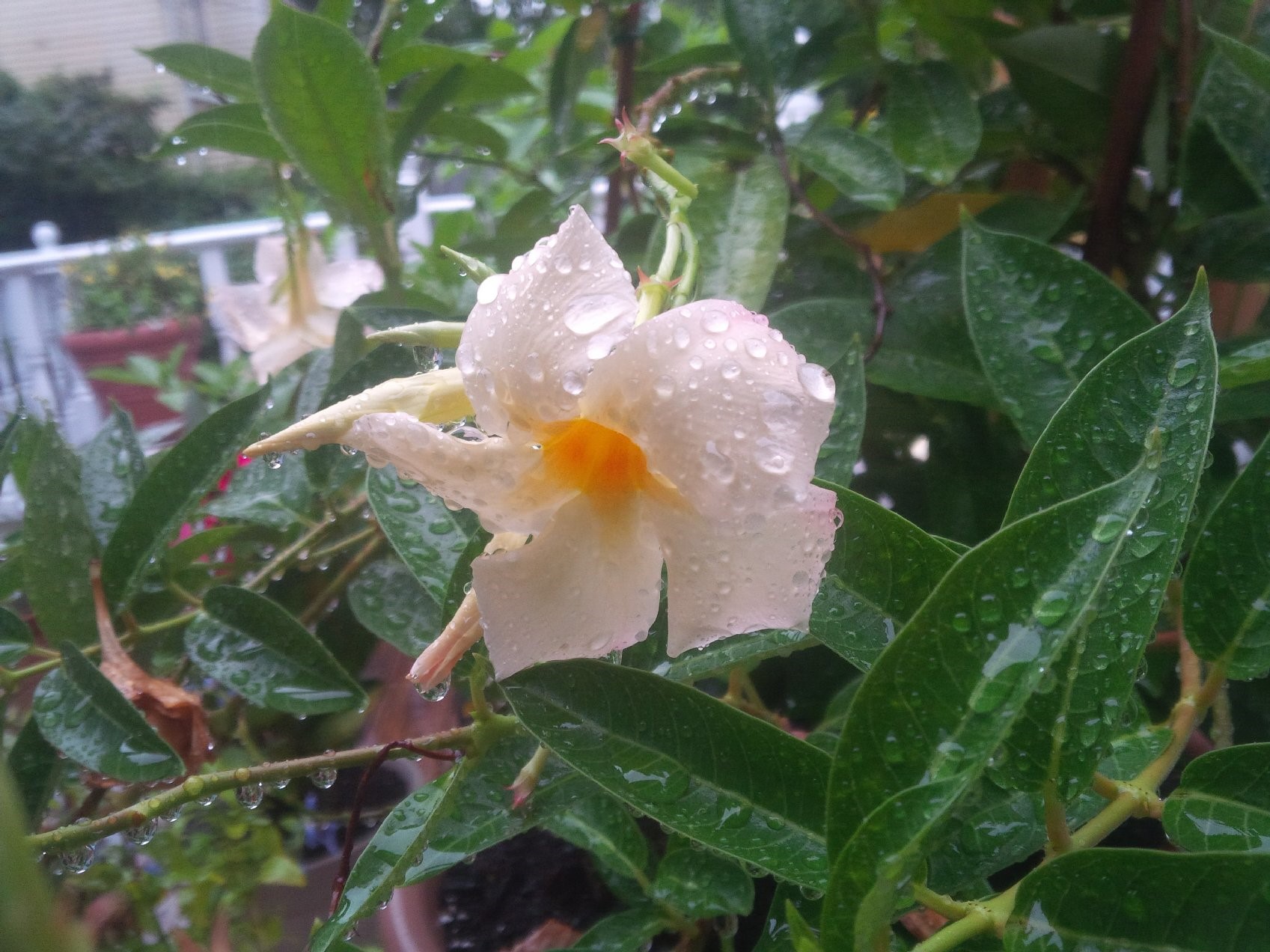
I grew three beautiful mandevillas this year and I really don’t want to lose them. I can cut them back and bring them inside, but I am running out of space, and no one has yet offered me a free greenhouse. That being the case, the madevillas will have to spend the winter in my chilly—but hopefully not freezing—garage. I am thinking of ways to persuade my daughter to take them there on one of her visits to the old homestead.
For the rest I am just going to have to wait on the weather and my recovery. With any luck the weather will remain fair and temperate for a little while longer and the recovery will be short and sweet. I will appreciate the garden even more when I can get back to it.