 Pity the poor ‘Duchess of Edinburgh’. She has been handled roughly and forced to make do without her accustomed level of support. But she is resilient, and like all true aristocrats, she has made a remarkable comeback from adversity.
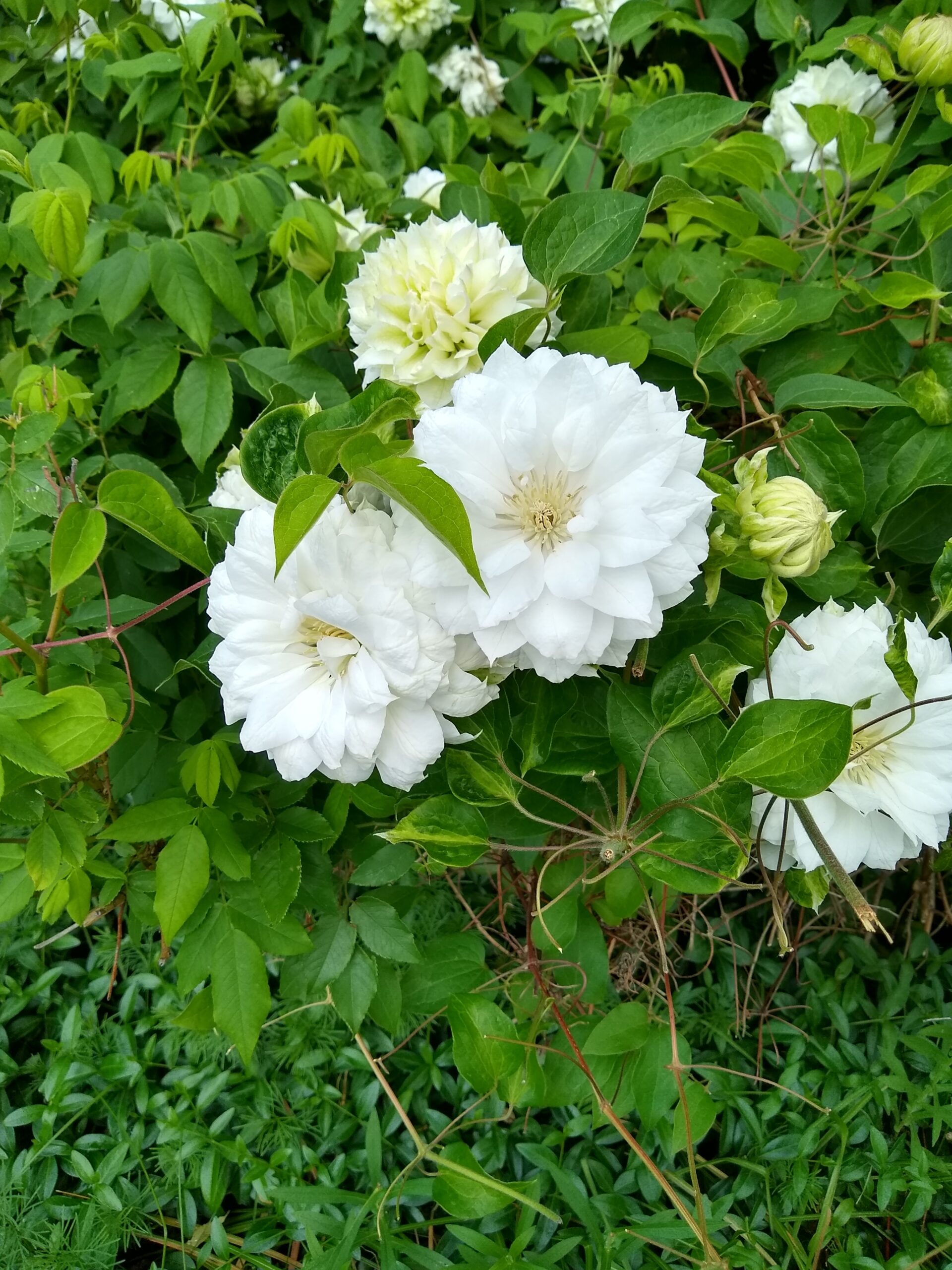
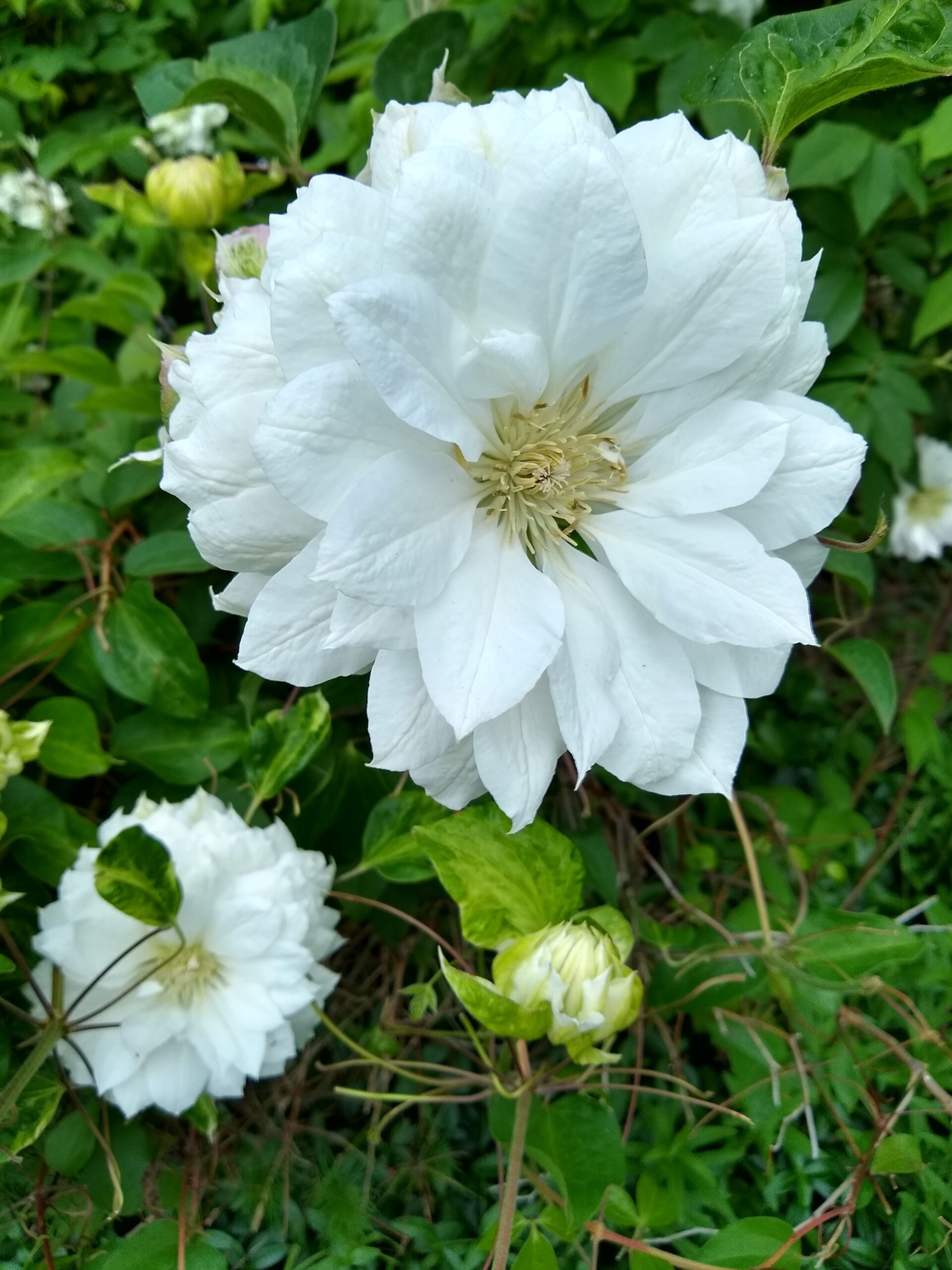
‘Duchess of Edinburgh’, is a stupendous double white clematis that has grown in my front garden for the last ten years or so. Until six weeks ago, the Duchess wound her way up and through an old-fashioned white shrub rose. The two complemented each other nicely. The clematis bloomed first, sending out scores of greenish flower buds that opened into long-lasting frilly white blooms. By the time those blooms had given way to delicate seed heads, the rose was sending out pink-tinged buds. The little roses were numerous, fragrant and bloomed in flushes throughout the summer. At the end of summer, ‘Duchess of Edinburgh’ would return, this time with semi-double white flowers. It was a perfect garden set-up, with contrast, succession of bloom and a nice symbiosis between the two plants.
Then rose rosette disease struck, engulfing the white rose. There is no cure, so one Saturday afternoon, I disentangled the clematis from the rose and dug up the latter. It was a sad day, and at the end of the process, the Duchess looked like it had barely survived a rather brutal coup attempt. I didn’t have an elegant support handy, but I tied the stems to a makeshift tripod of tall bamboo canes and hoped for the best.
Clematis is a member of the buttercup or Ranunculaceae family. The ancestors of today’s cultivated beauties were Chinese species like Clematis languinosa, white or lavender-flowered climber with compound leaves; or Clematis patens, also with violet to white flowers and pairs or trios of leaflets. In the nineteenth century, when plant hunters returned from far-flung regions with hundreds of new plant species, those ancestor clematis arrived in western Europe.
The first successful attempt to hybridize large-flowered clematis like ‘Duchess of Edinburgh’ came in 1835, with a new hybrid christened Clematis hendersonii, after the hybridizer, Mr. Henderson ‘Duchess of Edinburgh’ owes its existence to George Jackman and his son, George Jackman II, who began their own clematis hybridizing efforts in 1858. The Jackmans’ efforts ultimately led to their first successful introduction, the showy Clematis ‘Jackmanii’ which began a line of large-flowered clematis that continues to this day and includes ‘Duchess of Edinburgh’, introduced by the Jackman Nursery in 1875.
At the time, it was common in the floral world to name especially lovely new plants after prominent people. In this case, the prominent person was the Grand Duchess Maria Alexandrovna, daughter of Tsar Alexander II of Russia. The Russian Grand Duchess became the English Duchess of Edinburgh when, in 1874, she married Alfred Ernest Albert, Duke of Edinburgh, fourth son of the reigning English Queen, Victoria.
Maria Alexandrovna looks rather haughty in pictures, but her namesake clematis is flat-out gorgeous. Borne on climbing stems adorned with three-leafed foliage clusters, the Duchess can effortlessly scale trellises, tuteurs or other structures—including improvised arrangements.
After the rose removal, my Duchess looked forlorn for a couple of weeks. I wondered if the plant, deprived of its longtime companion, had lost the will to live. Eventually the Duchess and I both took heart, and the clematis began to perk up. New growth emerged and the stems resumed their upward progress. Ten days ago, flower buds appeared. It is late in the season, and I feared for them, but the weather has cooperated, and the petals opened wide. Clearly the plant was making a statement.
I plucked one of those blooms for display in the house. Detaching the flowers from the plants takes a little effort, as the twining tendrils are tenacious, but if you make the effort, the Duchess makes a great cut flower and lasts well in a vase.
The Duchess’ normal second flush of bloom, and even this November resurrection surprise happens because the plant flowers on stems that developed last year—“old wood”—as well as on stems that developed in the current growing season—“new wood”. Double flowers grow from old wood and semi-double ones on new wood. Cutting back the stems by about a third after the seed heads appear helps that process along.
Most gardeners call ‘Duchess of Edinburgh’ a “compact climber”, meaning that it rises no more than five or six feet. When I acquire a new tuteur or trellis, I won’t have to invest in a 12-foot behemoth. After the great upheaval, my stressed plant required some tying and encouragement, but normally the twining stems do the attachment work on their own. The only real cultural needs are part or full sun and regular moisture. Mulch is a help. Traditionally clematis are said to fare best with “heads in the sun and feet in the shade.”
My Duchess clearly likes having her aristocratic feet in the soil on my property. In the spring I will reward that affection and tenacity with a lovely new support. In the meantime, I marvel at this act of autumn resurrection.