
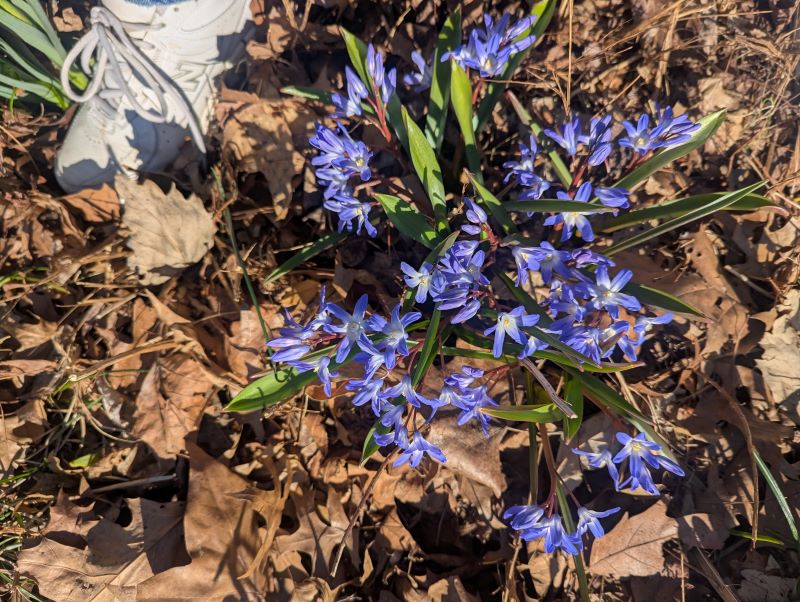
 The rarest flower color is true blue—not muddy blue-purple or questionable blue-pink, but bright, unabashed blue. That color is even more spectacular when it is set against a background of dull earth and comes after a winter onslaught of gray days.
I rejoiced in that color yesterday when the chionodoxa or “glory of the snow” opened wide on my front strip.
You may not know chionodoxa, but you have probably seen in on the edge of someone’s spring garden or, naturalized in lawn grass. It works both ways and delights both ways. Starting from small, fall-planted bulbs, the little “glories,” which are members of the hyacinth or Hyacinthaceae family, can rise to 12 inches tall. Mine and most that I have seen in my travels rarely rise taller than six inches. The flowers, which are grouped into loose clusters or racemes, open with six narrow petals apiece, fused at the base of each flower. Many chionodoxas feature white centers, making them look like stars. The stems are dark, and the relatively sparse basal leaves are grass-like. Chionodoxas are easy to miss until they open wide on the first sunny days of spring, and then they tend to startle .
“Glory of the snow” suggests that the plants work their way up through the cold ground and snow cover—at least in some neighborhoods, and probably in parts of the plants’ home ranges in Turkey, Crete and Cyprus. Not surprisingly, the name comes from two Greek words—“chion,” meaning “snow,” and “doxa,” meaning “glory.’ As wonderful as the flowers are to human observers, they are undoubtedly even more wonderful to the early bees, who are in need of sustenance after the long winter, pollinating the plants as they lap up the nectar in each bloom.
The most popular chionodoxas are Chionodoxa forbesii, named after botanist James Forbes, who lived in the late eighteenth and early nineteenth centuries, and served as gardener to the Duke of Bedford at his home, Woburn Abbey. At that time plants newly arrived from far-flung areas frequented by botanists—including the Middle East and Asia Minor—were often first grown on the estates of wealthy English plant lovers. I suspect the Duke of Bedford was among them. The gardens at Woburn Abbey are still lovely today.
Several species of Chionodoxa are available commercially, including Chionodoxa luciliae and Chionodoxa sardensis. The flowers are similar, no matter which species you choose. ‘Blue Giant’ is a forbesii variety with larger flowers than the species. This is especially nice if you only plant a few. ‘Pink Giant’ has the same flower configuration as other chionodoxas but bears pink star-shaped flowers. Chionodoxa luciliae ‘Alba’ bears pure white blooms, and Chionodoxa ‘Violet Beauty’ features medium purple trumpets.
Glory of the snow proves once again that good things come in small packages. Last fall you could obtain 50 good-sized bulbs for under fifteen dollars. The savings are greater the more you order. I never plant any bulb-grown specimen as a singleton. Instead, I dig large holes and plant odd-numbered groups of bulbs. You can easily plant fifteen chionodoxas in a single planting hole in ten minutes or less. Your initial investment will also increase because happy chionodoxas will self-propagate by way of bulb offsets, sometimes referred to as “daughter bulbs.”
This is how they naturalize, sometimes eventually increasing into large sheets that can persist in lawns even after the original gardeners are long gone from the properties.
Deer, who thwart many garden plans, do not generally snarf down glory of the snow. Squirrels, those ace diggers and backyard thieves, don’t eat them either, though they will occasionally dig up bulbs and replant them elsewhere. When a chionodoxa turns up in some corner of my yard far from the original planting site, I know that it is the result of “squirrel landscaping”. Generally, I leave the plants alone, unless they are in a place that might get trampled by human feet. In my ongoing efforts to make peace with the local fauna, I try to think of squirrel landscaping as a form of serendipity. It beats futile efforts to scare away the unscareable fluffy-tailed rodents.
Most bulb vendors are sold out of chionodoxa right now, but about the time the tulips start to bloom, the first fall catalogs will fall into mailboxes, often accompanied by “early bird” pricing for those willing to think about fall planting around Tax Day in April. Ordering a handful of chionodoxa bulbs may even help ease the sting of handing over cash to the government.