
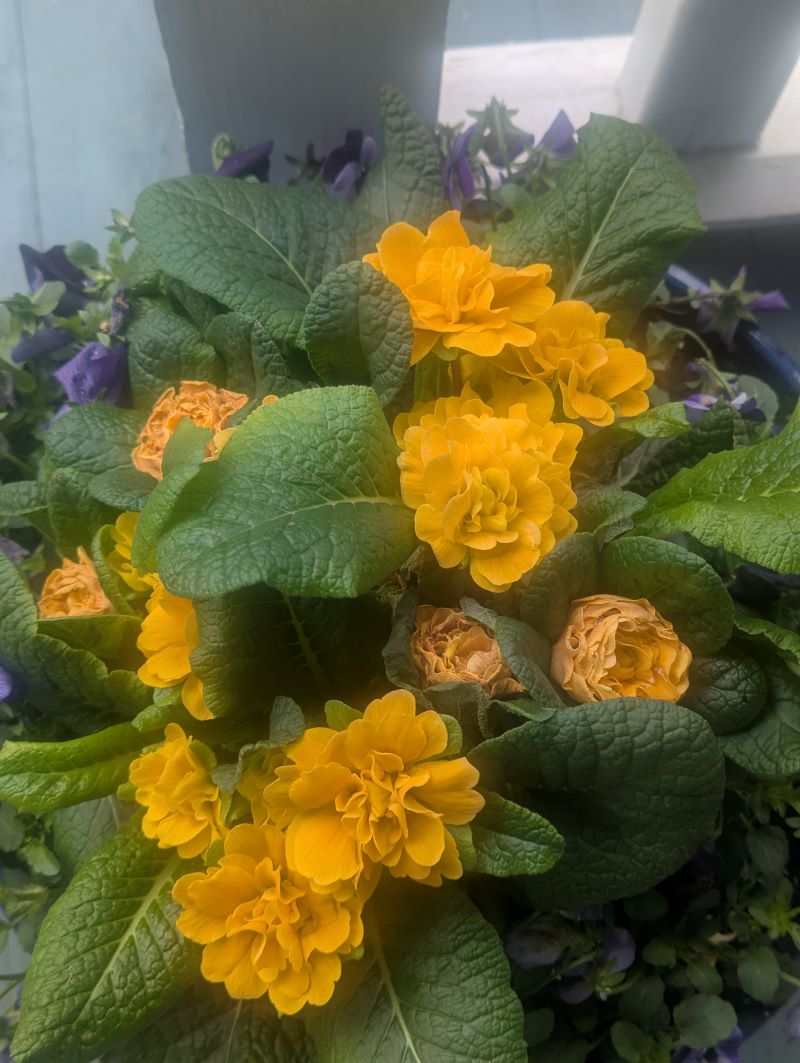
 Some years I crave simple things—flowers with only five petals, clothes without frivolous embellishments, and non-fancy food. Not this year. Life is complicated and it makes me crave opulent blooms. Fortunately, the catalogs and local plant vendors are offering luxurious double primroses in an array of colors. I have already bought several and may acquire a few more. They are relatively cheap and make the world seem a great deal more bearable.
The most popular primroses are varieties of Primula vulgaris, the common primrose, also sometimes known as Primula acaulis. Whatever you call them, the common primroses belong to a genus that is home to around 400 species. Primula vulgaris is native to western and southern Europe, but the plants made their way across the pond long ago and have found homes throughout North America and beyond.
Common primroses grow from a basal rosette of dark green, lettuce-like leaves. Generally the plants top out at about six inches and sport multiple flower stalks. In the species the blooms are pale yellow with five petals apiece. Breeders have long had their ways with primroses, expanding the color range to white, many shades of yellow, pink, purple, rose and red. Some primroses are bicolors with contrasting petal edges or central eye zones.
Over the years I have bought single-flowered primroses in the early spring, enjoyed them in the house, maintained them on windowsills until the soil warms up, and planted them outside in shady garden spots. A good number have returned year after year, with the blooms appearing like a welcome surprise each spring.
Single-flowered primroses are a heartening sight in grocery stores, big-box emporiums and garden centers at this time of year. They are often the first harbingers of spring and are especially welcome for those of us who have sustained ourselves through the end of winter by gazing longingly at catalogs and the African violet displays on retailers’ shelves.
But the primroses I want right now are the frilly double-flowered specimens. The most popular among them are the Belarina series. These beauties were bred by Englishman David Kerley, owner of the Kerley and Company Nursery, a family-owned business that bills itself as “Breeder of Novelty Patio Plants.”
Kerley’s success with double-flowered plants began not with a primrose, but with a petunia, ‘Priscilla’, named after Kerley’s wife, whose pollinating efforts resulted in the original plant. ‘Priscilla’, launched in 1996, bears double purple blooms and launched the Tumbelina series of double petunias that has since expanded to include 20 different named varieties.
Primroses came later, with the development of the Belarina series. This changed the primrose market dramatically, gradually bringing a host of varieties to market, each with fully large, double blooms somewhat reminiscent of small roses or begonias. The colors range from cream through yellows, pinks, purples, and especially blues. The Belarina blue primroses include the stunning ‘Baltic Blue’, the white-dappled ‘Blue Ripples’, and the dramatic ‘Watercolor Blue’ that is washed with overtones of cream. The Belarina range also includes fetching bicolored varieties, like ‘Maple Sugar’, with deep red petals accented with narrow gold petal edges.
The Belarina family has grown with the introduction of Prima Belarinas. These plants are even more compact and floriferous than the Belarina series, with the same brilliant colors.
If you are a frugal gardener, you are probably wondering if fluffy-headed double primroses like the Belarinas can survive long term in the garden. The answer is “maybe”. The horticultural trade markets the double-flowered varieties for quick, colorful display, either in-ground or in containers. The plants are only shipped in the spring, which reinforces that idea. If you want to try treating them as perennials, plant in partially shaded locations that receive consistent moisture. Make sure the plants are protected from strong winds and are well mulched.
Planted in spring after all danger of frost is past, double-flowered primroses have plenty of time to establish roots before summer’s heat sets in. If all goes well, the Belarinas and their double-flowered primrose relatives will dance through the summer and make a repeat performance the following year. It is worth a try.