
 In HMS Pinafore, one of the most celebrated Gilbert and Sullivan operettas, the character “Buttercup” introduces herself in song with the following words, “I’m called Little Buttercup, dear Little Buttercup, though I could never tell why.”
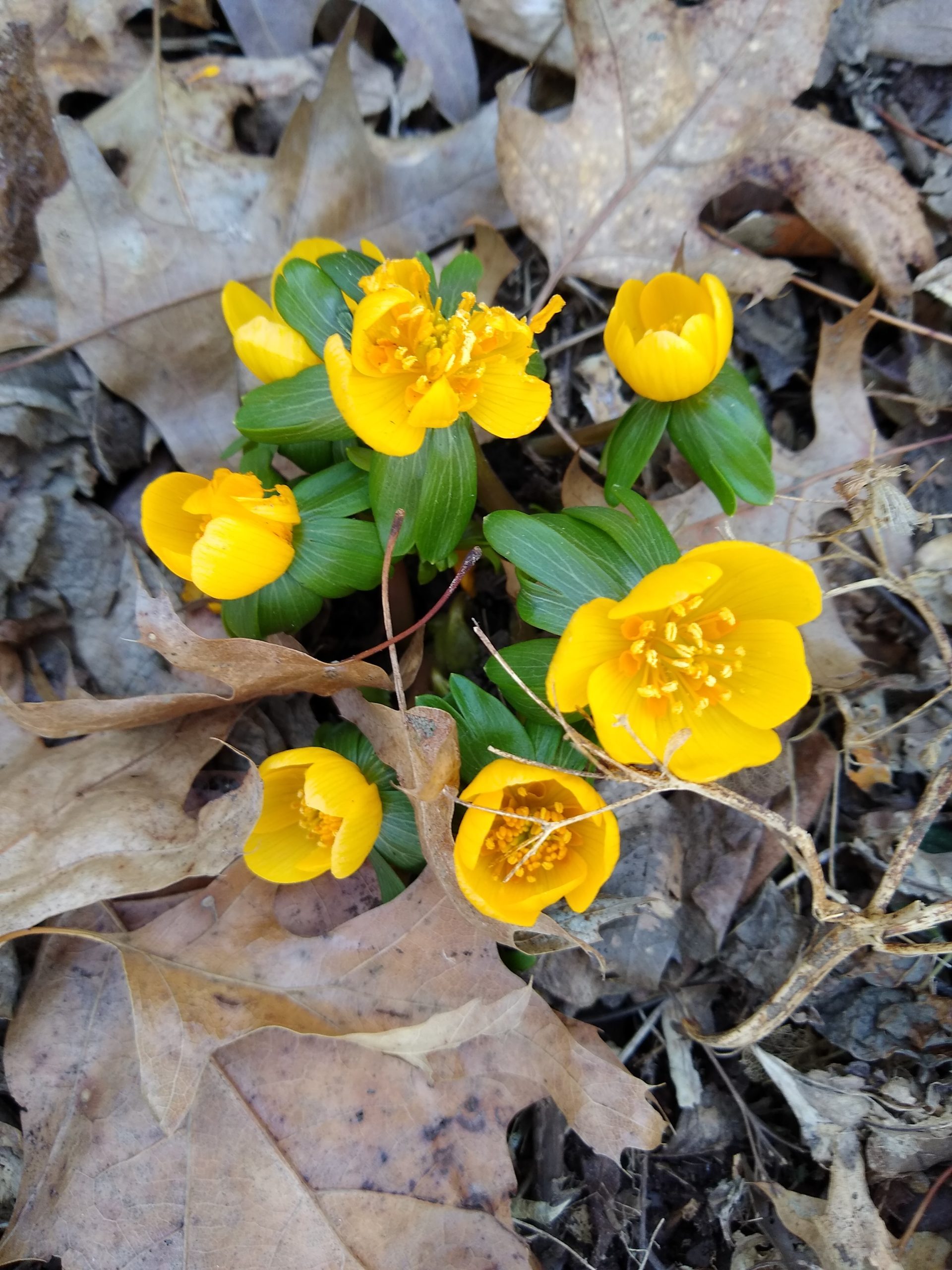
I thought of this the other day when I spotted the golden-orange buttercups now on display under one of the hydrangea bushes in my back garden. The sight of the golden orange flowers, petals wide open in the sun, made me want to burst into song after the long winter.
My “buttercup” is in fact a winter aconite or Eranthis hyemalis. Its buttercup-like appearance stems from the fact that it is a member of the large Ranunculaceae or buttercup family. Thought it might not seem so, it is buttercup time right now in the garden, as those other early spring buttercups, the hellebores, are in various stages of awakening as well. They need a few more weeks of climatic convincing before they will burst into flower, but the winter aconite is already there. Mine goes by the varietal name ‘Orange Glow’. The “glow” is real, though the orange is more a suggestion than a dominant color.
Eranthis hyemalis is a low grower, sprouting from rhizomes and reaching no more than six inches in height, with an equal spread. The little buttercups, which are usually yellow, but may be golden orange like mine, appear at the tops of the short stalks, surrounded by a ruff of green bracts. The true leaves, which sprout at the plants’ bases, come after the flowers are gone, and the entire plant disappears as early spring advances to mid spring.
Eranthis have flowered for centuries in their native areas—Western Europe, from southern France to Bulgaria, Turkey, Kurdistan well as Iran and Afghanistan. Eranthis hyemalis arrived in England early. The plants were first mentioned by the celebrated English herbalist John Gerard in his Catalogue, published in 1596, during the reign of the first Queen Elizabeth. At least one eranthis plant list mentions that ‘Orange Glow’ was first discovered in a Copenhagen, Denmark botanical garden. It was probably started off as a random seedling of a yellow-flowered plant. Once noticed and propagated, it made its way in the world, probably first in the gardens of collectors, and later in ordinary gardeners’ plots.
American listings for ‘Orange Glow’ are not plentiful. As with many other plants—especially specimens that I develop crushes on, ‘Orange Glow’ seems to be much more popular and available in Great Britain and Europe than it is here.
With international affairs the way they are, I was lucky that I did not have to cross the pond to get one. I received mine from snowdrop guru Hitch Lyman well over a decade ago. I don’t believe he has had sufficient stocks to sell it since. European catalog vendors sometimes carry this and other varieties, like ‘Guinea Gold’, which has yellow-gold flowers and bronzy foliage, and ‘Flore Pleno’, which boasts double yellow buttercups.
We Americans do not have to suffer, however, since the yellow-flowered varieties are readily available from bulb specialists. All you have to do is plant the bulbs two to three inches under the soil in the fall in expectation of spring bloom.
Your gardening friends and neighbors may not be privy to the beautiful secret that is winter aconite, but if they are, and you are on good terms, offer to trade a favor or two for a small clump lifted “in the green”, right after bloom time is over. Many experts think that this method is ideal for both winter aconite and snowdrops.
Some references say the plants do best in slightly alkaline soil, but mine have been fruitful and multiplied in the same acid soil that happily supports rhododendrons and azaleas. The original plant from nine years ago has now grown to about twelve flowering specimens,
And I have every reason to believe the expansion trend will continue.
If you start with live plants, give them a bit of water to help them get established. The bulbs, once installed in fall, pretty much take care of themselves. I think the more common types increase even faster than my ‘Orange Glow’ because they set seed very efficiently.
No matter whether you start with bulbs or plants, it’s wise to mark where you installed your winter aconites so you don’t dig them up inadvertently at times of year when they are dormant.
You don’t see winter aconite in every garden, but when you do, you are bound to feel better about everything, even if the day is a gray as moles’ fur. As the daylight returns to the landscape, the little golden flowers add just a bit more brightness.
Some merchandisers sell winter aconite as “Eranthis cilicica”, which may be listed as a separate eranthis species. Depending on the source, may alternately be classified as a group within the hyemalis species. Don’t worry about the confusion. The yellow buttercups are the same.
Barring donations from generous neighbors, a good source for winter aconite bulbs is Brent and Becky’s Bulbs, 7900 Daffodil Lane Gloucester, VA 23061; (877) 661-2852; www.brentandbeckysbulbs.com. Print catalog available.