
 Sometimes you can spend years wishing for a particular plant. You finally conquer distractions, procrastination, and financial considerations and install it in the garden. It succeeds so well that after about five years, you spend at least a little time wishing that you did not have so much of it.
This has happened to me repeatedly over the years with New England asters, perilla mint, roses of Sharon, Joe Pye-weed, and now with blue floss flower, known to its botanist friends as Ageratum houstonianum.
At this time of year, blue floss flower joins the cavalcade of daisy family members that ring down the curtain on the gardening season. The mums, asters and goldenrods are all part of the enormous Asteraceae family, which taxonomists now call by the less starry name, Compositae. All have great benefits to the end-of-season pollinators, not to mention gardeners and flower lovers who are now engaged in the great fall race to do clean-up, install bulbs, and order plants like holiday amaryllis in the short span of weeks before frost sets in and supplies of bulbs run low.
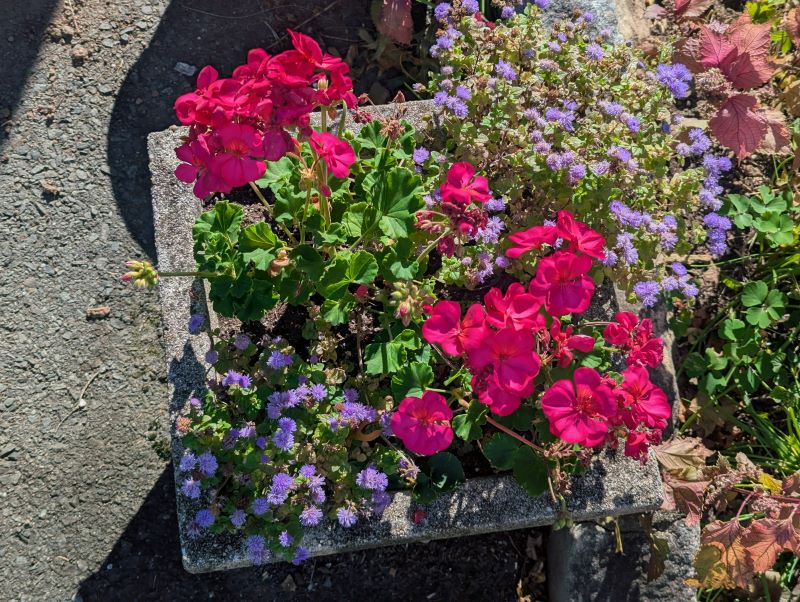
Rising from six to 24 inches in height, with a mature spread of six to 18 inches, blue floss flower keeps a low profile in the garden until late summer or early fall. The leaves are unremarkable—vaguely shield-shaped and toothed on the edges, adorning tall, slender stems. In a crowded cottage garden, you might even overlook the plants until the tiny flowers come together to erupt into fluffy blue clouds. As with the blue and blue-purple asters, the mellow autumn light makes those flowerheads glow. I have some in a cast concrete planter paired with magenta geraniums and the effect is stunning.
I would take full credit for that except that the plants were all spares and neither species was in bloom when they were planted. Serendipity is a wonderful thing.
Like many well-loved garden plants, the houstonianum species has acquired a number of evocative nicknames over the years, including “blue billygoatweed,” “bluemink,’ and “Mexican ageratum.” I cannot speak with authority on the Billy goat and mink associations, but “Mexican” refers to the plant’s origins in that country. The Latin name, “ageratum,” comes from two Greek words, “a,” meaning “not,” and “geras,” meaning “old age.” This is a reference to the fact that the flowers are long lasting—another plus as the season wanes.
Blue flossflower is an annual, but I have always thought that was something of a misnomer, since the plant is a flagrant self-seeder, effectively perennializing itself if left to its own devices. My garden is also full of self-sown white ageratum, which apparently blew in on the wind. Perennial ageratums are also available, with flowerheads that are very similar to those of annual varieties.
I am not sure how many years ago I planted the original blue flossflower, but it has spread merrily. Mine bears flowers of sky blue, but other shades are available, as are varieties with white or pink flowers. Tall types include ‘Blue Horizon’, which rises to at least 18 inches, and features blue-purple flowerheads, and the slightly shorter ‘Summer Stars,’ which bears powder blue blooms.
Many people like to use blue ageratum as edging plants. For them, little ‘Blue Danube,’ which grows only six inches tall, or ‘Blue Mink,’ at eight to 12 inches tall, may be just the right varieties. Container and window box gardeners will appreciate those smaller plants as well.
References sources will tell you that blue flossflowers like “well-drained soil with consistent moisture.” This is certainly optimal, but in my experience, the plants are not especially fussy. You can deadhead them to prevent self-seeding, but since they are lovely and long-lasting in indoor arrangements, the best option may be to pick as many as you like for that purpose while leaving a few to seed next year’s display.
Blue flossflower does not often appear on lists of “deer-resistant” plants, but the deer in my neighborhood seem to prefer other species. Butterflies and bees flock to them. Last week when both the cultivated blue flossflowers and their wild white siblings were in full bloom, my garden was abuzz with pollinator activity. Seeing the last of the monarchs feasting on the billowing flossflowers before their annual departure made me forgive the plants’ prolific nature. I’ll deal with the scores of offspring next year.