
 Inspiration comes at the strangest times and in the most unlikely places. The other day I was walking in a neighboring town, doing what I always do—looking at other people’s landscaping, envying some of the results, and imaging what I would do with less inspiring properties. This practice is highly satisfactory because it exercises my cardiovascular system and my imagination all at the same time. Life is busy and this kind of mental/physical multi-tasking is useful and pleasurable.
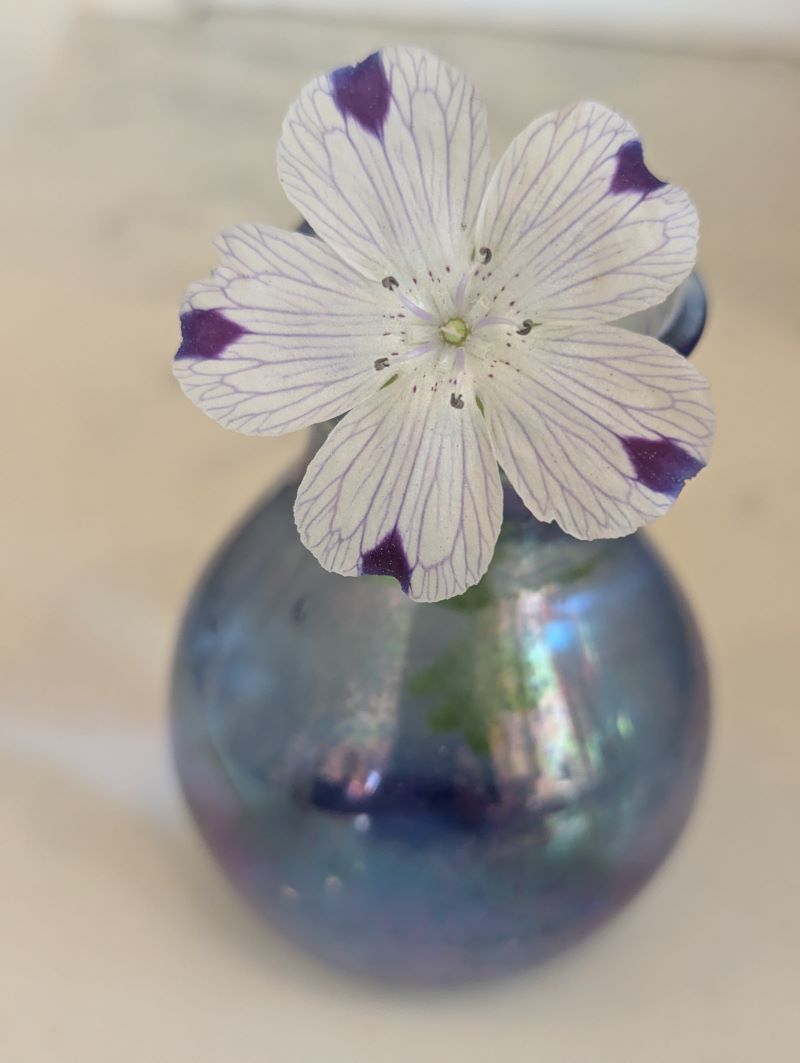
Passing by the edge of a property that was once home to a long-demolished estate, a flower popped into view. It was a low grower, no taller than a common violet, but the flower was different. On first glance, it looked a bit like a cranesbill or hardy geranium, with upward-facing flowers bearing five delicate petals apiece. Those petals were white and delicately veined in purple. The center of the outer edge of each petal bore a distinctive purple spot.
The only wrinkle in the cranesbill identification theory was the foliage, which while lobed, did not look like any cranesbill that I have ever seen.
The flower and its companions, sprinkled over the grass nearby, were so fetching that I vowed to find out more. I am not in the habit of spoiling pleasant walks by bringing out the cell phone, but when I got home, I used it to find the mystery plant. I had a vague idea that it was some kind of annual nemesia, but it was unlike any nemesia I have ever found in a garden center.
As it turned out, the mystery plant search strategy involved typing in “five spots” and “flower.” The lovely bloom was not a nemesia at all, but had a similar name, Nemophila maculata, commonly called “five spot.” A little additional research told me that the local five spots were specimens of an annual plant belonging to the borage family, and native to California. Its ancestors must have been planted in the estate garden, surviving over the years by self-seeding and being left alone on the untended property.
I figured that if the five spot succeeded under those circumstances, it could succeed in my garden.
The literature suggests that five spot plants like cool spring temperatures, flowering from April through June. Presumably they set seed during that period before dying back in the face of summer’s torrid heat. The last few years we have had long cool springs in my corner of the world, so I have high hopes for the Nemophila maculata seeds that should be delivered any day now. I will grow them in a sunny spot that gets some afternoon shade, making sure that the soil is rich and consistently moist. Sources say that the plants can reach heights of six to 12 inches, though the untended specimens that I saw were shorter than that. We will see how it works out in a slightly less neglected situation.
As it turns out, I have a connection to one of five spot’s close relatives, Nemophila menziesii, or “baby blue eyes”. Growing slightly shorter than five spots, baby blue eyes feature the same five-petaled configuration, but with azure-blue petals and white centers that give rise to the common name. Baby blue eyes is also native to California and nearby areas and seems to flourish under the same conditions as five spot. The dramatic blue of the petals is characteristic of many members of the borage family.
When I met my late husband, one of the first things I noticed was the very large, distinctive belt buckle that he wore. It was rectangular and gold-toned, with an etched flower design and the words “baby blue eyes” written in script underneath. My husband’s eyes were brown, not blue. I am not sure where or why he got the belt buckle, and for some reason I never asked, but he wore it often with casual clothes and kept it in the closet to the end of his life.
He was from the west, so I figured “baby blue eyes” had some meaning in his home area.
Doing the research on the five spot plant brought the “baby blue eyes” belt buckle and the memory of my husband back to me. I think I may order some baby blue eyes seeds to sprinkle among my five spots.
Memory, connection, and a bit of serendipity, like the discovery of the five spot flower, also make gardens just a little more beautiful.