
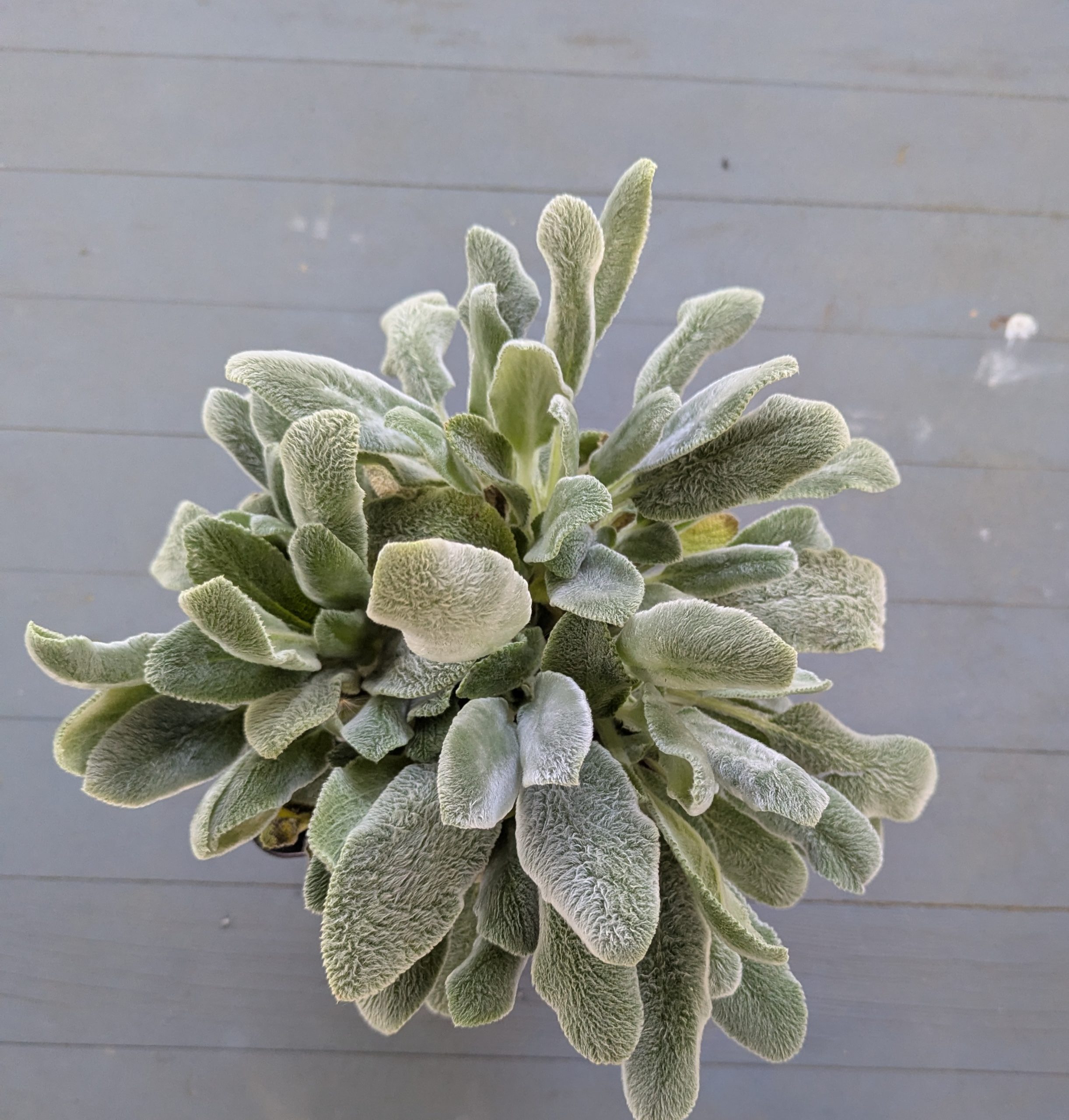
 I fall in love with some plants easily. Others take longer—sometimes a lot longer. That was the case with Stachys byzantina, known to its friends as lambs’ ears. It is not as if lambs’ ears wasn’t on my radar. When my daughter was small, she saw a bed of the plants, touched their soft, fuzzy leaves and was completely smitten. “I want to fall asleep in a bed of lambs’ ears,” she said, and I am pretty sure that she still feels that way as an adult.
Now, many years after that love-at-first-sight experience, I have several pots of lambs’ ears on my front porch awaiting installation in a new garden area. They are there at my daughter’s suggestion, but I have also come to value them as an ornamental plant.
Perennial lambs’ ears have acquired a variety of ovine nicknames over the years, including lambs’ lugs, lambs’ tails, and lambs’ tongues. The “lamb” part has to do with the softness of the gray-green leaves, which are covered with tiny hairs. If you are of a fanciful turn of mind, the shape of the roughly ovoid leaves might also remind you of either ears or tongues. The “byzantina” part of the Latin name refers to the species’ area of origin, which includes present day Turkey, Armenia and Iran.
You have probably seen lambs’ ears, even if you didn’t know what to call them. The plants grow nine and 18 inches tall, with a maximum spread of about 18 inches. The wooly leaves appear as rosettes and spread by way of underground rhizomes, leading some gardeners to use them as ground covers. In spring, lambs’ ears may produce flower spikes of tiny pinkish-purple flowers, but the spikes are most frequently described as “insignificant”. As with hostas, many people simply cut off the flower spikes, viewing them as superfluous to the more aesthetically pleasing leaves.
The hirsute nature and grey-green color of the leaves gives a clue to one of the species’ major virtues—drought tolerance. Silvery grey foliage reflects the harsh rays of the sun and the tiny hairs provide further protection. Reference sources often categorize lambs’ ears as “xeric” plants, suitable for landscapes where moisture is at a premium.
Stachys byzantina was introduced in Europe in 1782 and made its way across the Atlantic sometime after that. It is an old garden favorite, and its toughness has probably led to it becoming a “passalong plant” that gardeners bestow on each other. Hungry deer and rabbits avoid it, and the plants can survive dry rocky soil, proximity to toxic black walnut roots, shallow soil, and urban situations.
Unlike genera such as echinacea that are now home to hundreds of varieties, Stachys byzantina has not been monkeyed with by breeders. The most popular variety is ‘Helen von Stein’, which is sometimes also sold as ‘Big Ears’. ‘Fuzzy Wuzzy’ has the same winning qualities as other byzantina varieties but seems to grow a bit taller. ‘Silver Carpet’, on the other hand, is smaller, at six to eight inches tall, making it even more suitable as a low ground cover.
Stachys is a member of the large and diverse mint family. It is related to Stachys officinalis, also known as the herb betony. One of the major differences between the two stachys species is that officinalis bears showier flower spikes and is more often grown as a floriferous, drought-tolerant ornamental. Merchandisers capitalize on that trait and advertise officinalis plants for their attractiveness to pollinators and hummingbirds.
If you decide to invite these botanical lambs into your garden, site them in a spot that receives plentiful sunshine. The plants are tolerant of just about anything except shade and poor drainage. I plan to amend my sticky, moisture-retentive clay soil with sand or gravel to give my plants a congenial environment. The initial investment in drainage material will be more than offset by the fact that I will not have to invest in additional deer repellent to keep my lambs’ ears intact through the growing season.
Pasture your lambs in dry gardens, alongside lavenders, santolina, and sages. Use them as ground covers or edgings. Given congenial situations, they will spread themselves, but they are also eminently reasonable about being divided.
My young daughter had the right idea all along, and now my garden will no longer have to tolerate the silence of the lambs. Those lambs will be capering about and bleating up a horticultural storm as soon as I can get them in the ground.