
 It is exactly one week until my garden must look its best for the charity garden tour. After a washout over the long weekend when I had planned to move the planting scheme towards perfection, speed gardening has become the order of each day. Speed gardening means moving fast, focusing on the most visible parts of the landscape, and hiding anything that is unsightly or past its prime. Weeding means pulling or digging our the offending weeds and flinging them into piles for later disposal as mulch. And mulch has become essential to fight the unborn weeds and hide those that have evaded speed gardening.
But all the frantic activity is not without its immediate rewards. In the midst of removing the superannualed onion grass stalks, pulling up the abundant nettles and rooting out the over-aggressive Joe Pye-weed seedlings, I have rediscovered some long established plants. One of them is a gorgeous small rose, ‘Baby Faurax,’ currently starring in my upper back garden, hard by a container-grown azalea and an in-ground blueberry bush.
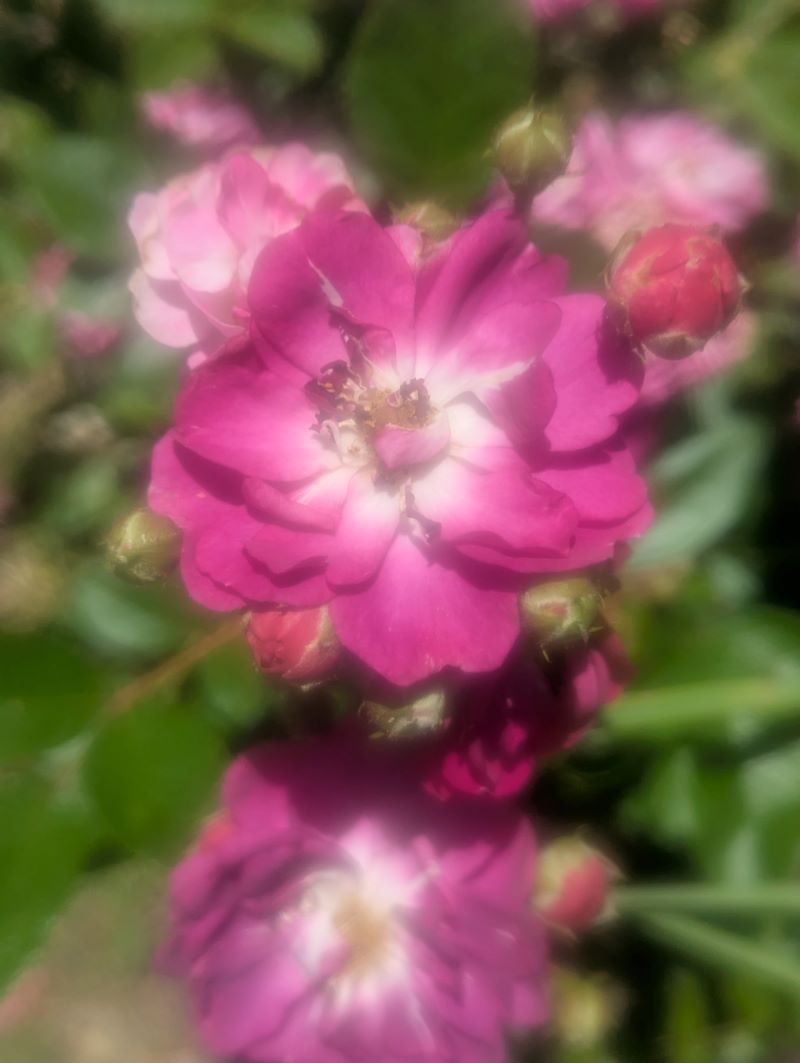
This rose, which my husband long ago nicknamed ‘Baby Clorox,’ features flowers that do not fade or ball up in the wet weather , a trait that bedevils some of its flashier rose relations. It does not droop either. It simply goes on blooming, in all its blue-purple splendor, putting other, larger roses to shame. The slugs may rampage through the hostas in the humid weather, but ‘Baby Faurax’ blooms on, untroubled by black spot or browned petals. A survivor of the Roaring Twenties, it is still the life of the party, almost a century after the repeal of Prohibition.
‘Baby Faurax’ is a native of France, born in Lille and introduced in 1924. It is part of a rose group known as the “polyanthas,” from the Latin words for “many” and “flowers.” Polyantha roses are generally small to mid-size shrubs that bear clusters of rosette or pompom-shaped blooms. In the case of ‘Baby Faurax,’ those flower clusters are an unusual shade of blue-tinged violet. The individual blossoms have about twenty petals apiece, each boasting a white central eye zone. The flowers are roughly an inch and a half across, clustered tightly atop stems that are upholstered with small, ruddy prickles. The prickles, while impossible to avoid, are not terribly sharp or intimidating, at least in my opinion.
I love to delve into the mysteries of rose parentage, and ‘Baby Faurax’ is a genuine enigma. The polyantha class of roses is the result of long-ago breeding efforts involving crosses between China roses and dwarf versions of Rosa multiflora. Most of us are familiar with the standard-size multiflora rose. It is the white “wild rose” that you see in untended spaces everywhere at this time of the year, covered with hundreds of small, five-petaled white flowers. Multifloras are fragrant and extremely attractive to pollinators, but nearly as invasive as Japanese honeysuckle. The shrubs tend to form thickets, outcompeting native species. Those in charge of botanical gardens, arboreta and public parks do everything in their power to make them unwelcome.
This is not the case with their better-mannered offspring, the polyanthas. One probable
polyantha hybrid, the blue-purple-flowered climber ‘Veilchenblau,’ introduced in Germany in 1909, may be a parent of ‘Baby Faurax’. The two varieties share flower form, clustering habit and the presence of white markings on some petals. Most prominently, they also share the singular purple coloring. DNA testing would undoubtedly ferret out the truth, but on the surface, ‘Veilchenblau’ bears a greater resemblance to ‘Baby Faurax’ than any other rose.
In this era of small space gardening, ‘Baby Faurax’ is perfect for limited pieces of ground or container culture. Grown in-ground, mine has reached a mature height of about three feet tall and two feet wide. It could easily be kept smaller, however, by pruning back the canes by one third at the end of each flush of bloom. The blue-purple flower clusters stay on the bush, rather than falling off and they last a long time. The blooms also hold up very well in cut flower arrangements, which is not something you can say about all garden roses.
‘Baby Faurax,’ which is lightly scented, also plays very well with others. Mine grows in a decidedly mixed planting scheme and I notice that it harmonizes beautifully with white-flowered Nigella damascena or love-in-a-mist. Purples and silvers go so well together that I can also imagine it paired with fluffy mounds of Artemisia ‘Powis Castle’ or a carpet of lamb’s ears. It occurs to me that my rose-loving father would have planted the little rose in the front of a dedicated rose bed, edged with masses of the fragrant herb, sweet alyssum, in purple and white. I haven’t bought any sweet alyssum in years, but in honor of Father’s Day, I just might buy some and plant it at the feet of ‘Baby Faurax.’
You can’t find ‘Baby Faurax’ in any old big box store, but you can find it at Rogue Valley Roses in Oregon. Their website, http://www.roguevalleyroses.com is a treasure trove of wonderful antique varieties, including the aforementioned ‘Veilchenblau.’ If you have the space, you might plant both, for a dramatic parent and child reunion.