Last week a major change happened in my garden. For many years four giant holly shrubs dominated the south side of my house. Two were probably planted deliberately by a previous owner, and two were likely self-sown, including one that was too close to the house. I am quite sure that the hollies started as reasonable-size shrubs, but years of neglected pruning—most of it before my time—allowed them to grow to tree size. On top of all that, the “trees” seemed to be ailing, dying from the ground up, as evergreens of other types often do.
It was time for drastic measures, and so, the tree company came and dispatched the hollies. Now I am adjusting to the new view from my living room and dining room windows and making plans for the new garden space.
The slightly sloped area faces south, which is great news for planting. I know that I want a mix of shrubs and perennials, anchored by a small tree that will be planted an appropriate distance from the house. A lovely Japanese maple will probably hold down that anchor spot. I would love a white-flowered rugosa rose, with its excellent fragrance and hardiness, so I will also order ‘Blanc Double de Coubert’ shortly.
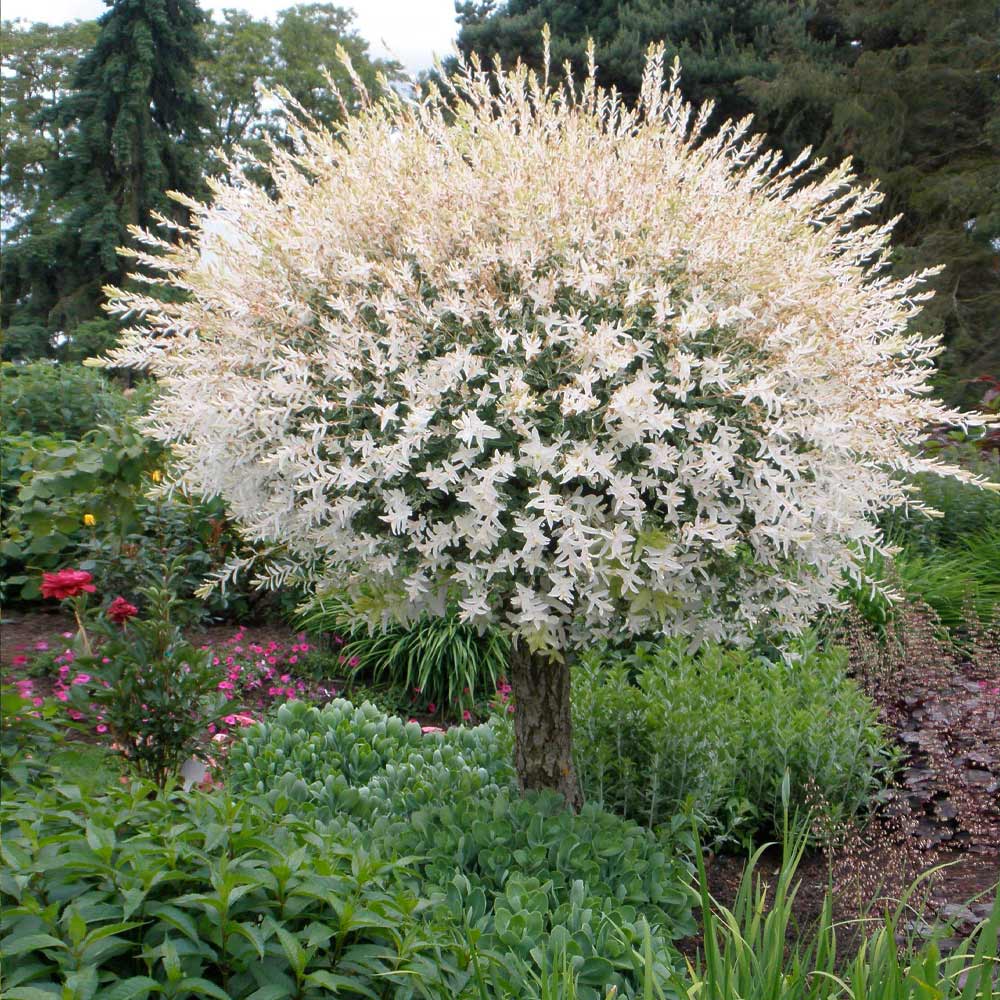
The space will hold a third reasonable-sized shrub, and that will be a dappled willow, Salix integra ‘Hakuro-nishiki’.
The parent species, Salix integra is an eastern Asian plant, native to parts of China, Japan and Korea. Left to its own devices, the deciduous species can grow up to 9 feet tall, boasting narrow leaves of pale green and reddish new growth.
Japanese breeders have taken Salix integra and improved on it with the creation of the wildly popular ‘Hakuro-nishiki’ variety. The common name, “dappled willow” tells the tale. The pale yellow-green spring catkins that are characteristic of willows give way to narrow leaves that are variegated with liberal splotches of cream and pink. That foliage turns yellow in the fall, before leaving the scene. In winter the shrub’s weeping form and the colorful new growth maintain interest until the catkins return.
Dappled willow was not born yesterday. It was developed in Japan—hence the Japanese name, which refers to the blended colors of the leaves–and was brought from there to the Netherlands in 1979 by the late Harry van de Laar, a Dutch botanist. Since it is colorful and easy to grow, ‘Hakuro-nishiki’ caught on. Now it is widely available and grown in large numbers by big plant vendors like Monrovia. Several years ago, Great Britain’s Royal Horticultural Society gave it the prestigious Award of Garden Merit—AGM—for reliability, beauty and other positive garden characteristics.
Many ‘Hakuro-nishiki’ plants are grafted specimens, with the named top growth grafted to a stronger willow understock. This is because dappled willow’s natural growth is thin and shrubby, making a sturdy trunk helpful. Because of the graft, many pundits suggest growing ‘Hakuro-nishiki’ as a standard or tree from in the beginning, pruning away any growth that sprouts from below the graft.
Willows love water, making dappled willow a good subject for damp spots or rain gardens. If you don’t have either situation, provide ample regular moisture to the plant, especially as it is establishing roots. A good mulch, applied doughnut-style to a depth of two inches, will help keep the moisture in the soil.
As I found out with the now-departed hollies, pruning is essential to keep plants shapely and healthy. Even though your ‘Hakuro-nishiki’ may have the ability to grow to nine feet, doesn’t mean that it will be attractive or fit your landscape at that height. Remember that it is almost impossible to kill a healthy plant by pruning it, so wield the clippers and loppers with confidence.