
 The plants that botanists sometimes call “spring ephemerals,” including trilliums, common violets and hepaticas, always seem magical to me. They push up through bare earth when warmer weather is still a vague suggestion, and proceed to flower, set seed and disappear, all in manner of a few months. Intellectually I know that ephemerals are always with us, lurking below the soil’s surface, but my heart still leaps when they appear.
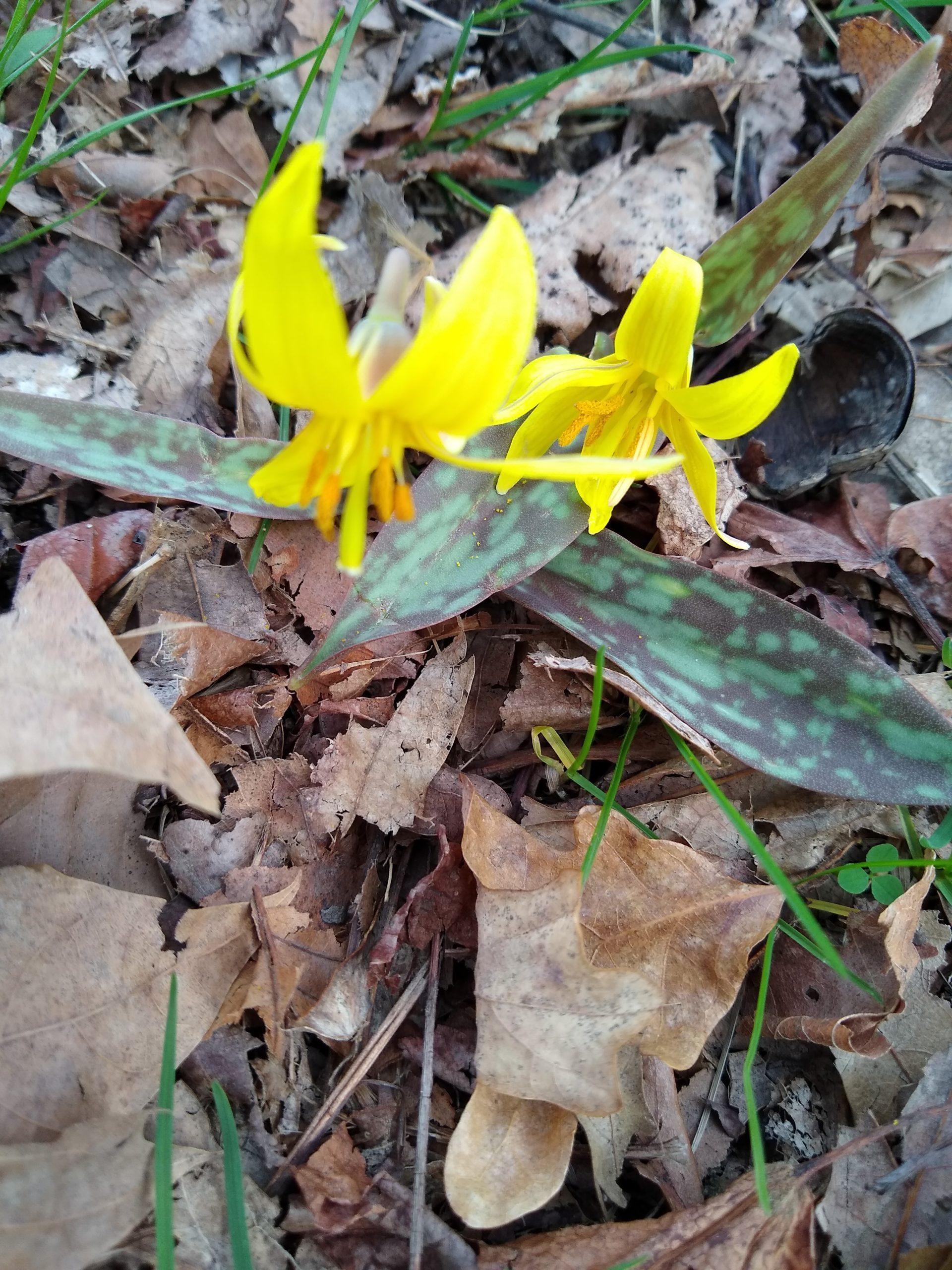
One of my favorites is the native dog-tooth violet or Erythronium americanum, a wildflower that has been appreciated in many times and places, including my 1918 volume of Wildflowers of New York State. While not a true violet, it goes by that name, in addition to many others, including adder’s tongue, trout lily, and fawn lily. I have never seen an adder’s tongue, but fawns and trout are generously dappled, a feature that defines the leaves of the dog-tooth violet.
I think the trout reference is most apt, because the leaves are long and slender like trout, colored earthy green and generously splotched with reddish brown. They grow low to the ground and are easy to overlook, even in spring when the plants are flowering. Dog-tooth violets frequently hide themselves in out-of-the-way places like stream banks and the moist edges of wooded areas. I have seen them on the margins of public parks in my part of the world, where most people pass them by or sometimes step on them without a second thought. They are the type of miracle that does not announce itself with fireworks.
While subtle, the flowers are beautiful and attest to their relationship to the lily or Liliaceae family. The nodding yellow blooms, which appear atop leafless stems, sometimes feature reflexed or back-turned petals with undersides brushed with pale purple. They never last long, but in the season, it is worth frequenting shady stream sides and other damp locations to find them.
Where does the “dog-tooth” name come from? Most people never see the small, pointed corms that give rise to leaves and flower stalks, but they look something like canine teeth. Happy erythronium corms will produce underground rhizomes, resulting in patches of dog-tooth violets over time.
There are about 26 species of Erythronium, concentrated in North America, plus a few cultivated varieties that are available in commerce. ‘White Beauty ‘, a variety of Erythronium revolutum, which has won the Royal Horticultural Society’s Award of Garden Merit or AGM, is native to the Pacific coast of the United States. The flowers are white, sometimes with red inner rings, atop stems that may be as tall as 12 inches. ‘Pagoda’, a yellow-flowered hybrid, descended from native West Coast plants, including the revolutum species, is another AGM winner. The flowers are somewhat larger and showier than those of either the Americanum or revolutum dog-tooth violet. For something a little different, try ‘Purple King’, a variety of Erythronium dens-canis, one of two dog-tooth violet species native to Europe. The medium purple flowers appear on small plants with the characteristic mottled foliage. ‘Frans Hals’ is another purple variety with similar flowers, and ‘Rose Queen’ features flowers with a purple-pink cast.
If you decide that you want a few trout lilies swimming through your garden, order them for fall planting. They should be located in shaded, consistently moist locations. When the bulbs arrive, plant them about four inches deep and four inches apart. Garden critters like deer probably won’t eat the corms or plants, but squirrels may dig them up and cast them aside. To prevent this, cover newly disturbed earth with chicken wire or strongly scented leaves of mint or lavender.
It goes without saying, that you should never collect dog-tooth violets in the wild. However, if a friend or neighbor has a successful stand of the plants, it doesn’t hurt to ask if you might have one or two. However, you acquire them, be sure to mark the planting locations so that you don’t dig them up inadvertently during the nine or ten months of the year when the little ephemerals are taking their beauty rest.