 As a nature lover, I am very fond of the nature series that British naturalist/broadcaster David Attenborough has produced and presented over the years. All of them highlight not only specific creatures and environments, but the interconnectedness of all living things. Not long ago, I was watching “Wild Isles,” about the wildlife of the British Isles. One episode featured an attractively marked British spider that is, as Attenborough announced, “as large as the palm of your hand.”
This description gave me an involuntary shiver. As much as I appreciate the role of spiders in my local ecosystem, I am not ready to experience one of that size. I think most people would agree.
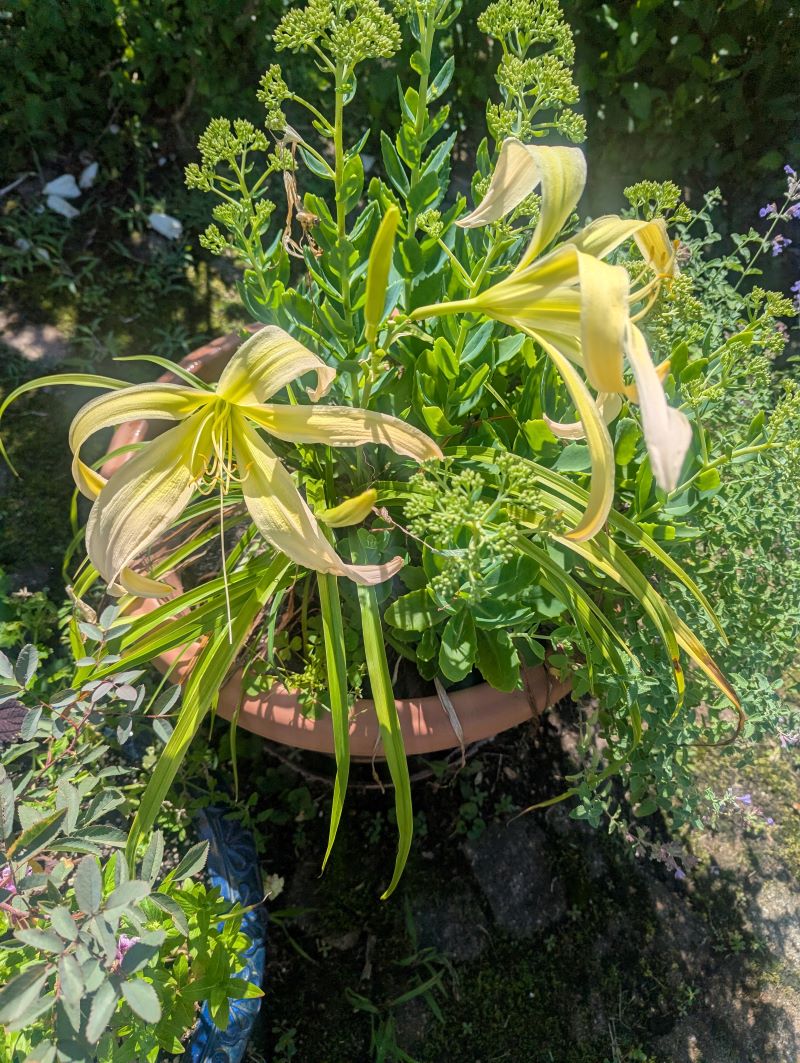
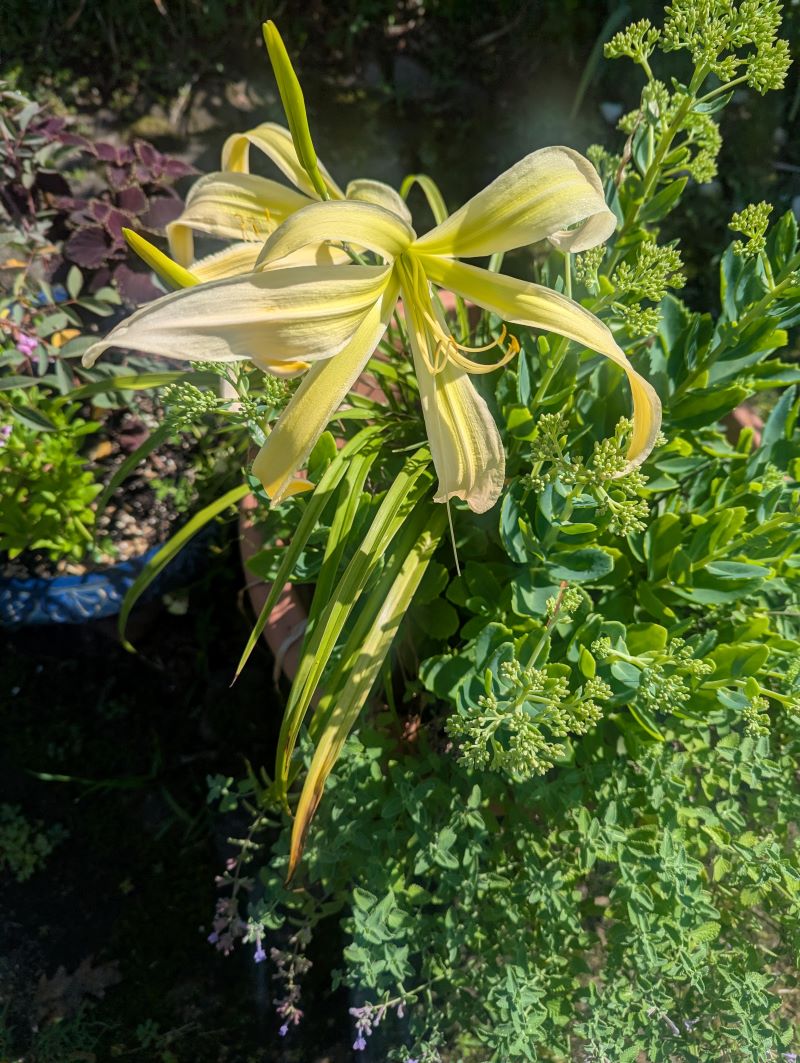
I do, however, have a spider even bigger than that in my garden. It is a spider-form daylily, and if you stretched out the slightly curling, ribbon-like petals of one of the flowers, it would be about 10 inches wide. Despite its name and impressive size, it is not frightening at all.
The American Hemerocallis society, which regulates the hemerocallis or daylily world, defines a spider-type daylily as “A flower whose petal length is four times the petal’s width or more.” While spider types are still in the minority among popular daylilies, they are gaining ground. One of the major American daylily growers list 42 spider varieties in its online catalog.
When I first started growing daylilies, I was enthralled by opulent flower forms with ruffled edges and big fat petals. Combining those traits with pastel colors created romantic landscapes. As my daylily collection grew, the individual plants gained in size, which meant that while individual blooms lasted only a day—hence the name—the bloom season continued for weeks in mid-summer.
As my existing daylilies branched out, I also branched out–into miniatures and varieties with “eye zones” –areas of contrasting color in the center of each flower. I was especially taken with the “eye zone” daylilies bred by the late Pauline Henry of Siloam Springs, Arkansas. Ms. Henry, who died in 2000, specialized in plants with that trait, and many of them also boasted the opulence that I craved. I agreed wholeheartedly with a statement she once made about how she selected plants for breeding. “Pretty on pretty” was her main criterion, and that still sounds good to me.
My daylily experience took a great leap forward about ten years ago, when I visited Grace Gardens, in Penn Yan, NY, a magical daylily garden and nursery. Operated for many years by a daylily-loving couple, Tom and Kathy Rood, it is still in business, with Tom continuing to run the garden since Kathy’s death in 2020
When I first visited a decade ago, it was early July, just before peak daylily bloom. Thousands of blossoms were already open, and the array of colors and forms was breathtaking. I found it impossible to leave without a handful of new daylily plants and the owners were generous enough to include a “surprise” plant in my package. The “surprise” was a yellow spider-form daylily. My bonus spider was the best kind of surprise—something that I wouldn’t have chosen on my own, but now find irresistible.
Fast forward ten years and that yellow spider is now blooming lustily in a large container in my lower back garden. It took a couple of years to get going, but now it produces more huge blooms every year, holding its own and holding the eye. I lost the original plant tag, but my yellow bloomer looks very much like a catalog variety called ‘Ladyfinger’. I wish that I could bring one or two stems inside to enjoy in my kitchen, but since the blooms last only a day, they are much better off in the garden.
If the long, slender petals of spider daylilies take your fancy, there are many on the market in all the daylily colors, from purest white through pinks, oranges, yellows, reds and purples. Some have ruffled petal edges, and a few have contrasting “eye zones.” If you like bicolors, with stripes of contrasting shades, they are also available.
Most daylily plants only bloom once during the growing season, usually in early, middle or late summer. These days, people want hard-working plants and daylily breeders have obliged them with rebloomers. A few of the spiders will rebloom if they are happily situated.
Life is hard, but daylilies are easy, unless you live in an area where deer are a problem. If that is the case, spray them regularly with a good repellent, surround them with plants like catmint or allium that deer detest, or grow them in a well-fenced bed. Beyond that, all daylilies need is a lot of sunshine and consistently moist soil. In cold winter climates, most go dormant during the cold months and re-emerge from the soil in spring.
An arachnid as big as your hand would probably send you running. A daylily as big as your hand would most likely be a source of delight. Unless you are David Attenborough, I recommend the latter.