
 Years ago, I planted three garden beds at my family’s summer cottage in the Finger Lakes region of New York State. Each bed presented a different set of soil and light conditions. One was adjacent to a shale beach, sunny and exposed with free draining soil. Another was partly shaded, surrounding the stump of a departed poplar tree. The third was sunny and positioned at the rear of a concrete retaining wall. The soil was compacted clay.
Knowing that the three beds would get minimal maintenance, I tried to choose plants that would take care of themselves. Each garden got divisions of a pale blue bearded iris, all descended from a plant given to me by a friend. The bed by the concrete wall received a pink rugosa rose, some daylilies that I bought from a local breeder, a few autumn-flowering anemones, a coneflower or two, and some low growing sedums and ajuga to cover the ground and fill the empty spots. The shale beach garden got another rugosa rose, some peach-leafed campanulas or bellflowers that I found naturalized on the property, and lots of lavender. A few years later I added in a coneflower and some coreopsis.
The stump garden became home to a butterfly bush on its sunny side and a couple of hostas—one of them variegated–on the shadier side. I added a tall Asiatic lily and a spotted bellflower or Campanula punctata that I bought at a stand up the road from our cottage.
Some years after I first planted the three beds, I sold my portion of the family property to my sister who lives closer to it, and consequently visited less often. The gardens get maintenance when I am around—generally in early July–and occasionally in between. Some plants have died while others have gone crazy and multiplied with wild abandon.
In the wild abandonment sweepstakes, the pink rugosa by the concrete wall has grown to impressive size while the spotted bellflower in the stump garden has multiplied exponentially. Near the pink rugosa, the fall-blooming anemones are in danger of becoming thuggish and elbowing out better-mannered ornamentals. On the shady side of the stump garden, the hostas are thriving and enlarging at a reasonable pace, while the sunlit Asiatic lilies grow taller year by year.
Inexplicably, the white rugosa in the beach garden died the first year, at the same time as its relative behind the wall took root and began its quest for garden domination. Only one of the lavenders on the beach survived, despite excellent drainage and abundant sunlight. The butterfly bush in the stump garden also died, possibly stampeded by encroaching campanulas.
The iris multiplied everywhere, to the point where some had to be relocated or removed. With the exception of the tawny daylilies, which thrive and multiply entirely unaided by human beings, the iris win the prize as the most adaptable plants on the place.
This year, when I arrived for vacation, I weeded all three beds and took stock of the situation in each one. Clearly some “holes” in these small landscapes needed filling. The local garden centers were full of plants, but once again, the goal was to fulfill the “right plant, right place” dictum and select specimens that could thrive in frequently adverse conditions.
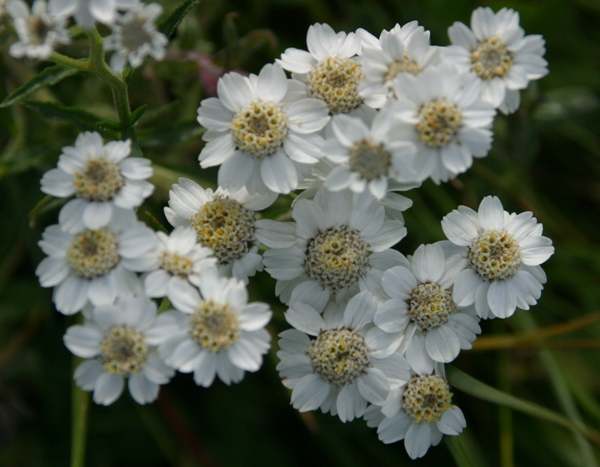
While walking one of the nearby rural roads, a partial solution came to me. I noticed wild white yarrow—Achillea millefolium–growing along the shoulder. Daisy fleabane, or Erigeron annuus, popped up everywhere. Farther on, I came upon a native bellflower or Campanula americana, thriving near a wooded area. Minty things, like wild catnip, were also going about the business of growing lustily, as were tall mulleins or Verbascum thapsis. Every farm featured a thriving clump of single-flowered hollyhocks, most often leaning against a structure. These biennial plants frequently self-seed, making them effectively perennial.
I decided to fill gaps in my little beds with plants that have already proven themselves in the local climate and soil. Yarrow varieties, bred from wild ancestors, are plentiful in the garden centers, as are pollinator-friendly mints, like Agastache, sometimes called “hummingbird mint.” They will go into the beach garden in planting holes lined with newspaper, which seems to help young plants establish themselves in spots where drainage is a bit too good.
The wayward rugosa has been cut back and a root sucker may go to the sunny side of the stump garden. I will probably divide the autumn-flowering anemones and transplant the divisions in the beach or stump gardens. Wild wood anemones flourish in this climate and their domesticated cousins seem to do so as well. I will think about some fleabanes.
The choices all come down to “right plant, right place,” but in this place “right” must also mean “self-reliant.” I am looking forward to checking the outcome next summer.