
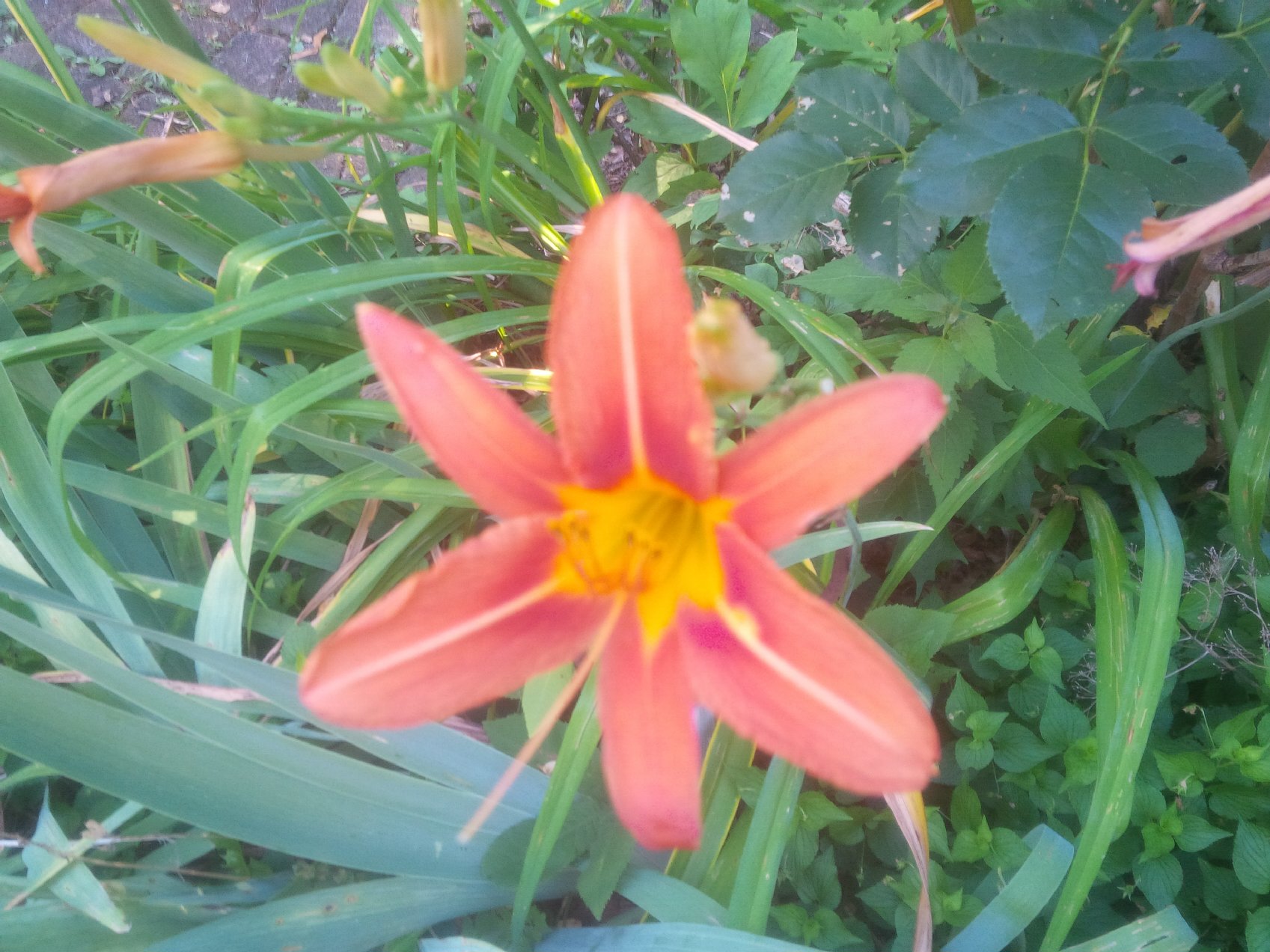
 A long time ago, someone actually planted a tawny orange daylily—Hemerocallis fulva—on purpose. I am sure the individual in question planted only one and was amazed five years later when it had morphed into an enormous clump and threatened to devour an entire landscape. That is what tawny orange daylilies do. At this time of the year they are everywhere, re-earning their long-held nickname, “ditch lily.”
They bloom ferociously in my yard, though I have never planted any. I assume that either a passing bird dropped the original seed or one hitchhiked back from our summer cottage and planted itself in the border. For some reason I have only pulled out a few of the clumps that have sprung up by magic in several different parts of the garden. Laziness has something to do with it, as always, but other considerations come into play as well. There are so few things in this life that flourish as reliably as tawny orange daylilies. It is probably bad luck to destroy one of them–something akin to looking a gift horse in the mouth.
Despite their ubiquity, these early summer beacons are not native to America. Hemerocallis fulva is native to Japan and, like other species brought to North America for ornamental purposes, it has made itself perfectly at home here since the nineteenth century. According to my battered but still-indispensable copy of Hortus Third, the tawny daylily has given birth to at least two cultivated varieties, one with variegated leaves and another, ‘Flore Pleno’ or ‘Kwanso’, with double petals. I have seen ‘Flore Pleno’, but have not set eyes on the variegated variety.
Though “ditch lilies” have not been favored by poets, they have been recognized by garden writers. One of the greatest American practitioners of that art, Henry Mitchell, allowed that common tawny orange daylilies were “handsome enough, massed with blue hydrangeas.” He was not fond of ‘Kwanso’ though, calling it an “intensely double, mop-headed form.”
The late Cassandra Danz, who wrote under the name “Mrs. Greenthumbs”, made a blanket observation that covered the tawny orange daylily along with every other cultivated hemerocallis, when she noted that all daylilies look orange from a few feet away.
Of course ditch lilies look orange even if you are passing them at fifty-five miles per hour.
Like almost everything else, they have their good qualities and one of them is erosion control. My sister and I ronce installed a few transplants to a naked hillside on our central New York State property, in the hopes of preventing mud cascades in the rainy season. We also planted a cotoneaster, one of the newer, less prolific roses of Sharon, and a few white and pale yellow daylily varieties for contrast. Fifteen years later, only the rose of Sharon is visible, soaring above a solid mass of tawny orange daylilies. Instead of being deluged by muddy water in the spring, we are now permanently deluged by ditch lilies. The well-mannered yellow and white plants have been subsumed and the cotoneaster struggles along. Occasionally a tendril surfaces, bearing the characteristic red cotoneaster fruit. It would take the removal of at least twenty daylily plants to give the cotoneaster enough room to thrive. It will probably be easier to move the cotoneaster to a safer location—after making sure that not a single daylily root was left clinging to it.
Ditch lilies also attract pollinators and tolerate clay soil, drought, air pollution and browsing rabbits. The tender buds are tempting to deer, but even those voracious plant devourers seem to prefer the more expensive hybrid daylilies over their more common relations.
As with all invasives, daylilies migrate, colonizing every available space and outcompeting native plants. According to the Invasive Plant Atlas of the United States, Hemerocallis fulva has been reported as “invasive” in most of the eastern half of the country and a few pockets in the West.
So what is to be done? Fill your garden with better mannered daylilies, which are available by the millions in every retail outlet. If, unlike me, you are immune to superstition, you could pull up all the self-sown ditch lilies that pop up in your own garden. Plant lots of true lilies, like ‘Casablanca’ and ‘Stargazer’, as well. These bloom slightly later than the tawny orange daylilies, but are beautiful, floriferous and non-invasive.
There is probably little to be done about the rest of the tawny orange lilies that surge over the landscape short of diverting the entire National Guard to assist in their removal. I suggest enjoying them as you drive by the vast ditch lily swathes out in the country. After all, Hemerocallis fulva may be excessively vigorous, but it is neither illegal, immoral nor fattening. There is something to be said for that.