
 Part of the fun of gardening is discovering and growing new plants. There is nothing better than scrolling through online venders’ websites, or, even better, strolling through the display pallets at the garden center, and feeling the thrill of love at first sight when an unfamiliar species or variety comes into view.
Last week I scored a new plant “hat trick” at my favorite garden center, when I discovered three highly tempting specimens. Since they also had the benefit of being relatively cheap, I bought them all, and they are now in my holding area, awaiting garden deployment.
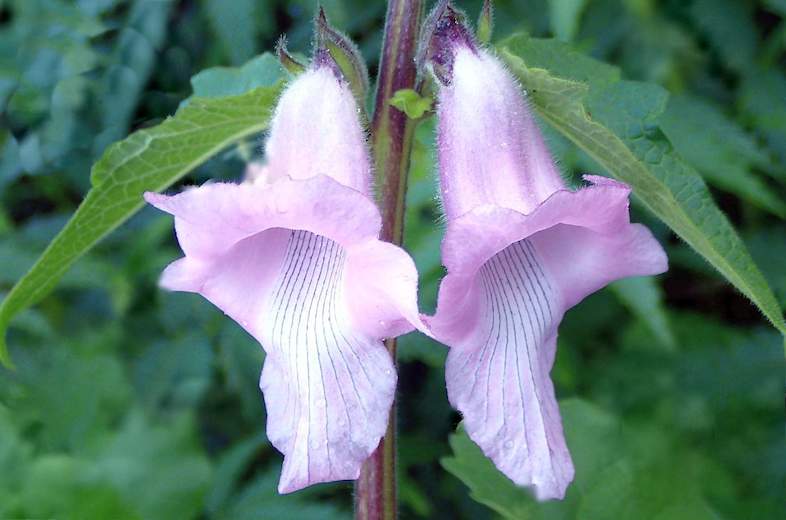
The most captivating of the trio is Ceratotheca triloba, commonly known as “South African Foxglove”. The species is sometimes also known botanically as Sesamum triloba. Sometimes common names are complete misnomers, but that is only partially true in the case of the South African foxglove. Though the showy flowers are foxglove-like, the plants are not related to true foxgloves, which are part of the digitalis genus. “South African” is right on the nose, as Ceratotheca is native to that country, as well as Botswana, Zambia, Zimbabwe, and Mozambique.
My new false foxglove—another common name—is an annual plant that can grow up to six feet tall with the flowers borne at the tops of relatively slender stalks. The large, dark green leaves have, as the botanical name suggests, three lobes each. The flowers are bell or thimble-shaped and somewhat larger than the typical foxglove blooms. They are most commonly pale purple, sometimes tinged with pink, accented with darker stripes, which are like bee runways. If you have ever seen a large bumblebee wedging its body into a common foxglove, you can imagine a similar scene with South African foxglove plants.
Clearly breeders have not yet had their way with Ceratotheca triloba, but a white-flowered variety is available commercially. Both the white and purple varieties are especially nice for moon gardens.
Given that South African foxgloves are not digitalis species, where do they fit in the great horticultural family tree? The alternate botanical name, Sesamum triloba, provides a clue. Ceratotheca is a member of the sesame family, best known for culinary sesame seeds, which come from the related Sesamum indicum. The plants bearing the famous seeds have similar foxglove-like flowers, though they are not as showy as the South African species.
Sesame seeds arrived in the Americas with enslaved Africans and caught on to such an extent that Jefferson grew the plants at Monticello. South African foxglove probably made its way to America a bit later, but fits comfortably in the garden with other heirloom annuals like true foxgloves, snapdragons and wallflowers.
Both the sesame seed plant and the South African foxglove feature leaves that may taste bitter when raw, but can be cooked and eaten. In the latter case, the leaves can be treated like spinach.
If you want to try growing Ceratotheca triloba, you can either start with seeds, and plant indoors several weeks before the last frost date for your area, or buy plants from the garden center at this time of the year. They will most likely be shelved with the annuals. In larger establishments, the foxglove look-alikes may be included with an array of unusual or new annuals, the better to be snapped up by novelty-besotted consumers. Either way, the plants should be situated in sunny spots that have good drainage. Water to establish the roots, and because annuals tend to be hungry, feed regularly with commercial plant food, diluted according to manufacturers’ directions. As with most annuals, deadheading will inspire continued flowering, which should take place from June through frost.
Online sources are somewhat limited, but seed vendors carry seeds of both the purple and white varieties. Try Select Seeds, 180 Stickney Hill Road, Union, CT 06076; (800) 684-0395; www.selectseeds.com. Print catalog available.