
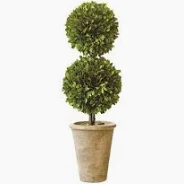
 In winters past, I thought about keeping boredom at bay by doing all kinds of things—migrating to a warmer climate, cleaning out the cellar, or finally applying a needlepoint cover that I made five years ago to a naked chair seat. To date, none of those things have happened. This year I am thinking smaller. I am considering creating a topiary.
The individual that the Romans called “topiarius” could have been any person employed as a landscape gardener. Clipping trees, shrubs and other plants into fanciful shapes might have been part of his—always “his”—responsibilities, as some wealthy Romans were fond of such things. In the centuries since Roman times, the topiarius epithet has fallen by the wayside, but “topiary” has come to mean a form of living sculpture created largely from evergreen plants and maintained with the use of clippers, garden shears, and, more recently, electric or gas-powered hedge trimmers.
Over the centuries, the topiary art form has waxed and waned as part of the eternal back-and-forth between formalism and naturalism in gardens. In his book, A Celebration of Gardens, English garden maven Roy Strong quotes early seventeenth century garden writer William Lawson, who wrote, “Your Gardiner can frame your lesser wood to the shape of men armed in the field, ready to give battell; or swift running Grey hounds…” Satirist Alexander Pope responded a year later, writing, “A Citizen is no sooner Proprietor of a couple of Yews, but he entertains Thoughts, of erecting them into Giants,…”
Clearly gallons of ink and thousands of man-hours of labor have been expended over hundreds of years in the service of, or in opposition to topiary. It has survived and thrived. In England, great estates are littered with evergreen beasts and shapes. King Charles showcases large-scale topiary at his Highgrove estate. Here in the United States, topiary ornaments one section of the Longwood Gardens public horticultural establishment. In 1988, Pearl Fryar, a sharecropper’s son, began cutting artistic shapes out of bargain specimens on his property in Bishopville, South Carolina. His topiary array grew and grew, receiving increasing notoriety until it was recognized as a national horticultural treasurer. Now, with Pearl Fryar in his late eighties, efforts, including the founding of a nonprofit entity, are being made to ensure that the garden is preserved.
Not all of us can be Pearl Fryer, but if you have even a modest amount of gardening skill, you can create topiary. I first did it in a very amateurish way, by standardizing some of the rose- of-Sharon shrubs that I acquired along with my present property. Standardizing is simply taking a shrubby plant, isolating a strong leader or stem, trimming off all the growth below a certain point, trimming the remaining growth into a ball, and clipping when necessary to maintain the desired shape. Sometimes this also involves braiding or tying a couple of strong stems together to support the plant. Either way, it is relatively easy and a good way to free up space at ground level for lower-growing specimens.
You can also create compact topiaries using a wide variety of smaller plants. At holiday time, I saw lots of topiarized lavenders and rosemary plants for sale at the local garden center. Some geraniums, especially those with smaller leaves make good topiary subjects, and I have seen beautiful examples done with annual coleus.
If you want to start a topiary and you have lots of time, root a cutting from an established plant, let it grow to six or eight inches tall, and start the process by isolating the strongest stem or stems. Clip off all the leaves on the bottom two-thirds of the stem or stems, tie stems together, if necessary, shape the top growth lightly and let the baby topiary grow, watering and feeding as necessary and continuing to trim leaves that sprout below the top growth. If quicker results are more to your liking, buy a mature plant and use the same procedure. You will still have to wait for time and growth to perfect your topiary’s form, but the wait will be considerably shorter.
Start now, while snow is on the ground, and you may be able to have a lovely small topiary by summer. Home-grown topiaries also make excellent gifts for plant-loving friends.
Since my dining room window seat is home to both geraniums and coleus grown from last summer’s cuttings, I will probably start with one or both of those species. I may not create green sculptures of greyhounds, frogs or loaves of bread, but I can enjoy my neat little tree-form plants.
It beats contemplating the frozen landscape on a dreary day.