
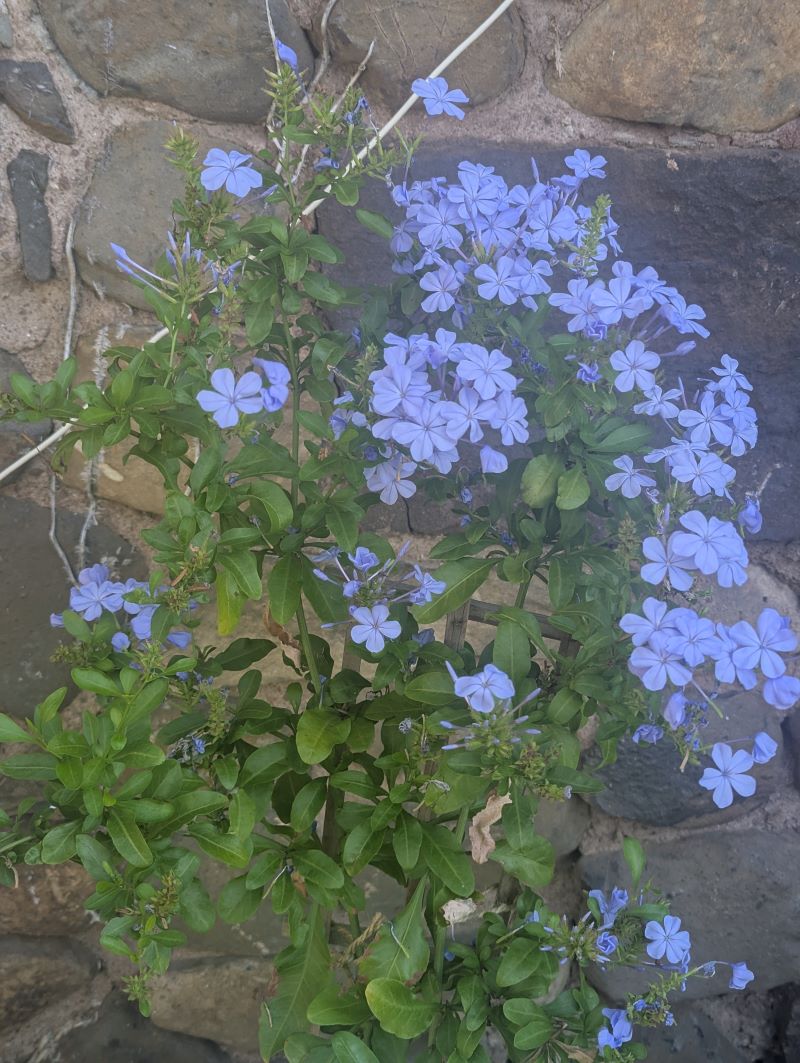
 It has been at least four years since I last grew the lovely plumbago, with its cascading habit and sky-blue flowers. This was not because I had grown tired of plumbago, but because my last plumbago grew tired of me and died. I did not take it personally, since the death happened in January, as the plant was overwintering. At the time I did not miss its lovely blooms because I hadn’t seen them in months. I was not motivated to buy another specimen because I know it would be months before I would see abundant flowers again.
Time went by, and like a formerly-favorite song, plumbago waltzed in and out of my mind a few times, but never at the right time for a purchase. Finally, when I needed quick color to make the garden more appealing for a July garden tour, I bought a new plumbago. Installed in an upcycled rattan container in the upper back garden and backed by a south-facing wall, the plumbago is flourishing, producing scores of cerulean blossoms in seemingly endless succession. I wonder how I ever survived without it.
Plumbago auriculata is the species most frequently sold by various retailers. It is native to South Africa and was discovered there in the eighteenth century. The shrubby, evergreen plants, which can grow one to three feet tall and equally wide, can be trained to climb if you have the inclination. The long flowering stems may remind you a bit of blue phlox, with small oval-shaped leaves and five-petaled flowers that are most often blue, but may also be gray-blue or white.
“Plumbago” is from the Latin word “plumbum”, which refers to the mineral lead. This is probably a reference to the lead-blue color of the petals of some plumbago flowers. According to Martin Rix, co-author of The Botanical Garden, the ancient Roman naturalist Pliny suggested that plumbago might be used as an antidote to lead poisoning. Later, observations like Pliny’s would be understood as an example of the “doctrine of signatures”, under which plants were thought to resemble the body parts or conditions that they might be used to heal. The plant’s Latin name undoubtedly gave rise to its common name–leadwort. It is also sometimes known as “Cape primrose”, for its South African origins, or “Cape leadwort”.
My plumbago is ravishing in its sunny garden setting, and I expect it to remain ravishing until frosts threaten. Sadly, it will not survive outdoors in places where fall and winter temperatures drop below forty degrees Fahrenheit. If you are wealthy, I suppose this means that you might also treat plumbago as an annual. The rest of us need to grow the plant in a container and haul it in when late fall rolls around. This is a pain in the neck, but generally worth it When your specimen comes into the house, give it a sunny corner and it will get through the winter nicely, benefitting from a haircut and a reduced watering schedule.
If you do not live in a cold winter climate, you can use masses of plumbago in borders or even as a low hedge. I can’t think of anything more beautiful than twenty of thirty feet of blooming leadwort.
If you are not training the plant to grow as a climber, trim it regularly to make it bushy and floriferous. Since it is native to relatively dry areas, water when the soil feels dry to the touch.
My new plumbago, purchased at a local garden center, did not have a trademarked name. If you are looking for one of your own, you will have the best luck at nurseries and garden centers that carry Monrovia plants. That company offers two plumbagos, Royal Cape®, sometimes sold by the varietal name ‘Monott’, and the white-flowered White Cape®, which also goes by ‘Monite’.
I have never tried propagating plumbago, but if you are game to do so, take stem cuttings during the growing season and strip off the lower leaves. Dip the cut ends in rooting hormone and insert in either a glass of water or moist soil. Keep the soil moist but not wet, and place in indirect light. Rooting may take a bit of time, but you should eventually see roots in the water, or new growth on the soil-grown cuttings. Layering, which involves selecting one or two strong stems, stripping off leaves, and pinning the stems so that those leaf nodes are in constant contact with the soil, may also work. When you see strong young growth, you will know that roots have formed. Detach the new plant from the parent and pot it up.
Outdoors plumbago works nicely with summer daisies and daylilies, especially those that flower in shades of cream and pale yellow. It would also work well planted in a large container alongside Coreopsis verticillata ‘Moonbeam’.
And, of course, if you are the proud owner of one of those pricey antique lead garden statues, underplant it with leadwort. It will be a perfect match.