
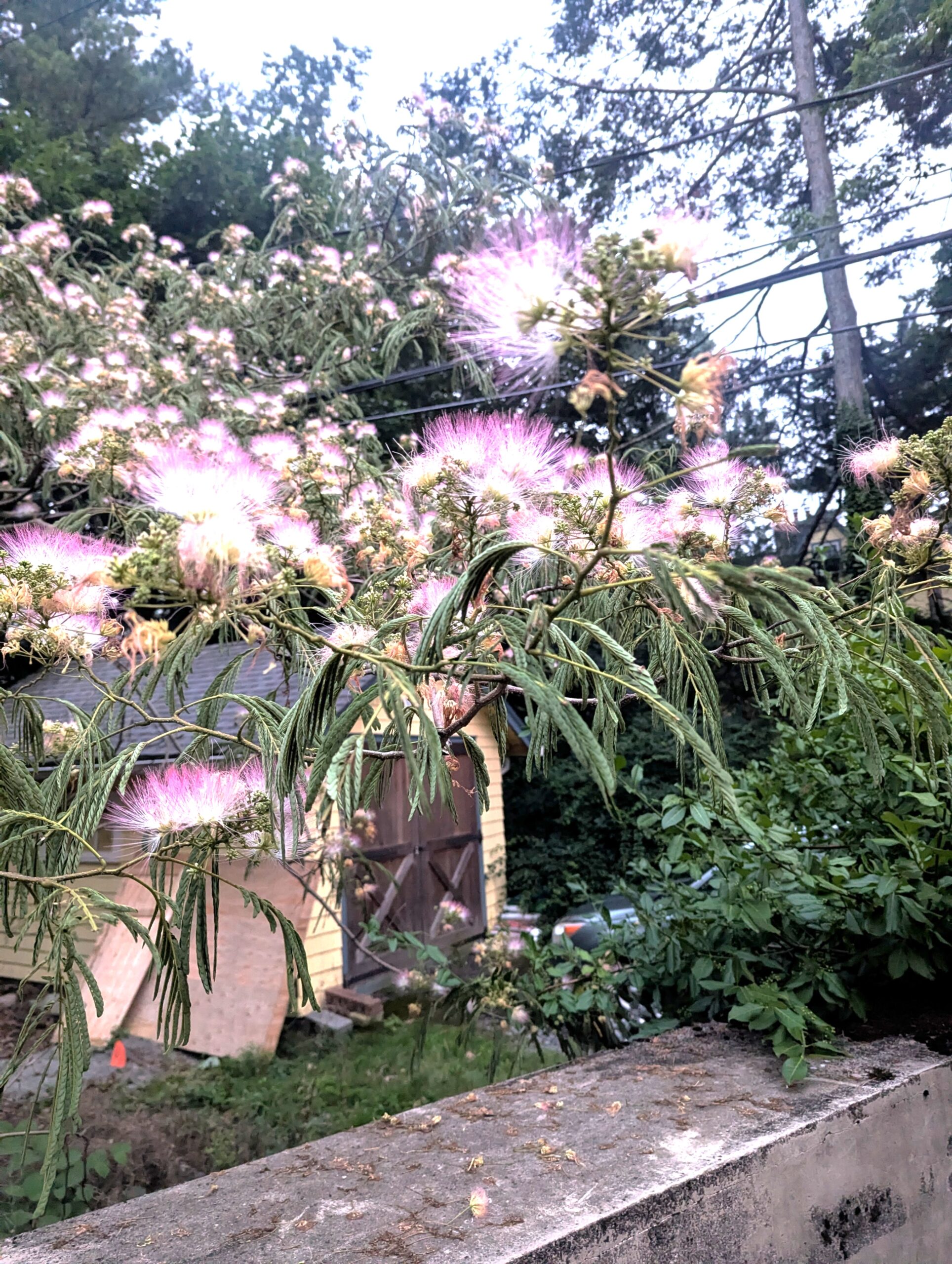
 Filippo degli Albizzia was descended from a family of Florentine power brokers that made successive economic and political splashes in that city beginning in the fourteenth century. At various times members of the Albizzia family, armed with a fortune made in the wool trade, were politicians, important churchmen, mistresses of churchmen, and inquisitors. Filippo was none of those. In fact, he was an eighteenth-century naturalist, best known today for introducing the mimosa tree or Albizia julibrissin to Italy in 1784.
The mimosa trees in my part of the world are blooming right now, in mid-July. Sadly, ninety-nine percent of the people who pass by them at 55 miles per hour or get a whiff of the fragrant flowers while walking the dog, would never know about Filippo degli Albizzia. As my father used to say, “Sic transit gloria mundi”—”Thus passes the glory of the world.”
It may be just as well, since the mimosa tree has a rather mixed reputation. Native to the southern part of Asia, from Iran to Japan, its nicknames– Persian silk tree, pink silk tree, or mimosa tree—are in keeping with its origins. The plants are trees or large, multi-stemmed shrubs that can grow quickly to a height of 20 to 35 feet tall, with a vase-shaped habit culminating in a flattened crown. The compound leaves, made up of lots of tiny leaflets, are distinctive and feathery or fernlike in appearance. They are also somewhat sensitive, curling at night and sometimes, when touched.
You might walk right by a mimosa when it is not in flower, but once the flowers appear, it is hard to miss the glorious display . Each flower “puff” is white at the base shading to either darker or lighter pink, depending on the variety and growing conditions The puff-like appearance is caused by the bouquet of long stamens protruding from each flower. Mimosa blooms are also intensely fragrant, attracting attention from pollinators and nearby humans.
As with all good things, mimosa flowers do not last long, and are succeeded by the long seedpods that distinguish the trees as members of the legume or Fabiaceae family. The leaves do not color up before their fall departure from the trees.
Mimosa trees are adaptable to a variety of soil and climate conditions, though they are not cold hardy in places where winter weather is extremely cold. Because of their self-seeding nature, they often spring up in out-of-the-way locations like the edges of streams, roadside ditches and field verges. The most impressive mimosa in my neighborhood is a large specimen that grows untended along the edge of a small stream. It appears to be about 20 feet tall and blooms impressively.
As with so many plants that arrived in North America amid high hopes for their potential as ornamentals, mimosa trees have proved to be problematic. Their adaptability and efficient seed dispersal have made them successful to the point of invasiveness in some areas of the country, especially the southeast. Though they are attractive to pollinators, mimosas have the potential to outcompete the native plants for which some of those pollinators are adapted.
It seems counter-intuitive for such an adaptable species, but mimosas are also susceptible to a number of pests and diseases, including the serious fungal ailment, Fusarium wilt. The wood is also relatively weak, making the trees susceptible to broken and splintered branches in the high wind situations that are becoming increasingly common in many places. Compared to many other ornamental trees, they are also short-lived, surviving about 30 years. For those concerned about “litter”, mimosas offer lots of it in the form of faded flower parts and crispy seed pods. This is not a problem when the trees grow in waste spaces, but may be annoying to suburban homeowners who prize tidiness over all things.
Gardeners who are thinking about mimosas have to consider both the bitter and the sweet. Breeders have not gone overboard with new cultivated varieties, but at least one, the pink-flowered ‘Tryon,’ is reputed to be resistant to Fusarium wilt. ‘Flame’, with red flowers, offers a more dramatic show than mimosas with the typical powder-pink blooms. Searching the commercial marketplace for either variety may involve a bit of work. It is also a good idea to consult with local cooperative extension agencies or tree experts to find out whether mimosas are considered invasive in your area.
I have a habit of falling in love with plants that dazzle me with bloom and fragrance, and mimosa has done so. Still, I think that if I were to consider a permanent relationship with a summer flowering tree, I might look for stronger wood and less invasiveness.