
 Many people grow Japanese maples on their properties. The trees are longtime favorites of landscapers and gardeners for their beauty, variety, versatility and three—sometimes even four–seasons of landscape interest. Billionaires spend large sums on rare specimens, but apartment dwellers can buy bargain maples and grow them in large containers. They are at once great plants and great equalizers.
But what is a Japanese maple? The easy explanation is that it is a member of the genus Acer that is native to Japan and parts of Korea and China. The more complicated explanation is that any one of the 24 maple species native to Japan can be called “Japanese maple”. The trees that most of us know by that name are varieties of Acer palmatum, the most commonly available Japanese maple. And the number of those varieties is staggering. The smallest dwarf Japanese maples may only grow one to two feet high. Their taller relatives can reach 25 feet. The trunks may be relatively straight or artistically contorted, giving the trees a sculptural quality during the leafless winter months. Growth habits may be upright or weeping. Some boast umbrella-like leafy crowns that are much wider that the plant’s height.
Denise Wyles Adams, in her wonderful book, Restoring American Gardens, mentions that Acer palmatum was introduced into the United States in about 1830. The trees caught on, with ‘Atropurpureum’, a red-leafed variety, and ‘Dissectum purpureum”, with red, deeply incised leaves, available through nurseries by the end of the nineteenth century. Those varieties, or their descendants are still available from nurseries today.
“Palmatum” means “hand-like”, which describes the configuration of many maple leaves, including those of Japanese maples. Acer palmatum leaves are lobed or divided, with some that are so deeply dissected that they have a feathery or ferny appearance. When you are looking through plant lists or catalog offerings, the word “dissectum” in the plant name indicates deeply divided leaves.
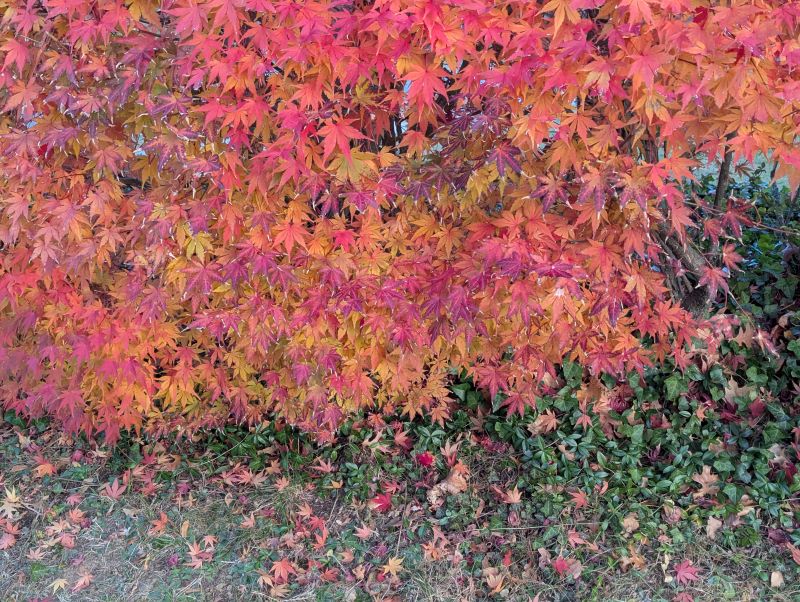
When it comes to providing color in the garden, Japanese maples do yeomanlike work as specimen trees, focal points of mixed shrub and perennial borders, accents in Asian-themed gardens, and colorful additions to container arrays. During the growing season, the leaves may be shades of green, ranging from bright chartreuse to deep forest. Other varieties boast red or purple foliage in spring and summer. Still others, like the lovely ‘Kagiri Nashiki’ bear variegated leaves in shades of pink, green and cream. Fireworks break out in the fall, when the maples color up in vibrant yellows, golds, oranges and reds. Right now, in mid to late November, many Japanese maples still have most of their leaves, providing brightness on exceptionally dreary days when the hours of daylight are slowly but surely diminishing.
And while leaves are most often the outstanding feature of Japanese maples, some, like ‘Beni-Kawi’, with red bark, also have lovely branches and trunks.
If you love Japanese maples, rejoice, because many growing spaces can accommodate them. Among the longtime favorites is ‘Bloodgood’, which grows up to 20 feet tall, sporting purple-red leaves during growing season that transform into vibrant crimson in fall. The smaller ’Crimson Queen’ is a weeping specimen with lacey leaves that only reaches 10 feet tall at maturity. The “crimson” in its name refers to spring and summer color, which is closer to dark red. Autumn turns that dark red to shades of green, yellow, orange and bright red.
For container growing, specimens like ’Red Viking’, which glows scarlet in the fall and reaches only three feet tall, with an eight-foot spread, provide brilliant color on a compact plant.
If you decide that your landscape needs a Japanese maple—or another Japanese maple—local nurseries and garden centers generally offer at least a few varieties. Online vendors sell and even greater selection. Remember to take note of the plant’s projected mature height when you buy it, so you and the tree will feel comfortable about its location. Plant in full sun or light shade and amend heavy soil with organic material. Mulching is also a good idea, as long as the mulch does not touch the tree trunk.
Japanese maples tend to be slow growers, but are beautiful in every stage of life. Perhaps the best advice on these lovely trees comes from woody plant guru Michael Dirr, who said, “buy small plants and enjoy their formative years.”