
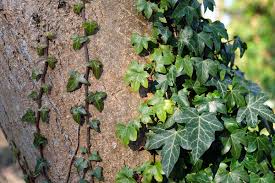
 The south side of my property between the front and back gardens has always been the weakest link in the landscape. Next to the house, four tall English hollies dominate the scene. I am sure they were lovely shrubs when they were planted by the previous owner. By the time I arrived, they had grown to tree size, with two of them snuggling uncomfortably up to the house, and all of them blocking light from hitting the ground around them. Over the years I have had a tree company come and trim the hollies, but they are still too big for the space.
That ground has long been dominated by low-growing yellow archangel or Lamium galeobdalon on one side of the path that bisects the area, and English ivy on the other. I like the lamium, which is indestructible and sprouts yellow, snapdragon-like flowers in the spring. I could do without the ivy. The transition area between the crepuscular south side and the front garden features a “bridal veil” spirea shrub and a weigela grown in standard form with bigroot geranium—Geranium macrorrizhum—at their feet. A “peegee” hydrangea, also grown as a standard, arches over the boundary between side and front. I like all of them, but they would look better without the shadow of the hulking hollies looming over them.
To add insult to injury, the hollies seem to have taken on the trait that is common to some conifers—dying from the ground up. The lower branches still protrude out over the path, but now those branches are bare and spindly-looking. The overall vibe is one of darkness and neglect.
It is past time for a serious remedy.
This fall, if my pocketbook has not taken too many serious hits, I will have the tree company take out the two hollies that are encroaching on the house. That will open up the space to light and air. The other two will be trimmed back to reasonable size, giving the area a more civilized appearance while allowing the local cardinals, robins, blue jays and catbirds to continue the practice of turning the hollies into bird condos during the nesting season.
The tree surgery will allow me to do a more effective trimming of the spirea and weigela, providing them with a more floriferous future. I will replace the departed hollies with a couple of shrubs that are better sized for the space. One may be dappled willow or Salix integra ‘Hakuro nishiki’ , with green leaves tipped with cream and pink. The other might be a shrub that I have long craved, Caryopteris clandonensis, or blue mist shrub. With scented leaves and stunning blue flowers, it will add color to the area in early fall.
I will attempt to get rid of much of the English ivy, and encourage the spread of the bigroot geranium to cover the same ground. Of course, fighting English ivy is an effort akin to the myth of Sisyphus, so I expect it will continue for some time.
It is bulb planting season, and I envision the newly lightened area underplanted with an array of crocuses, grape hyacinths and daffodils that will grow up through the bigroot geranium and/or ivy. I might indulge in some species tulips, but am wary of deer depredation. Whether or not I gamble on tulips, I want the ground to be dominated by bright color come spring. Tariffs have made Dutch bulbs more expensive, but I will order in wholesale quantities to maximize the investment.
In gardening as in other areas of life, it is always best to have a Plan B. If other demands on my pocketbook make fall tree surgery impossible, I will work with loppers, pruning saw and hatchet to rid the hollies of their gruesome lower branches. Even that step will provide a bit more light and improve the overall appearance of the side garden. The bulb order will go in on schedule and pruning of the other shrubs will take place no matter what. I will limb up the beautiful yellow magnolia on the other side of the path to provide a bit more light for the ‘Rosa Mundi’ that grows fitfully near its base. I would never take down a tree during nesting season, so I would simply delay the holly removal until next fall in the hopes that my late Victorian house will not need drastic repairs in the meantime.
I will also remind myself that good things come to those who wait, and that gardening is all about process. No matter how my plans develop, I will enjoy the process of turning the garden’s weakest link into a strong connector.