
 If you watch BBC Gardeners’ World, as I do, you will know that every single garden includes a water feature. Estate owners have them, of course, but so do gardeners whose landscapes consist of an array of containers ranging down a back alley. If you are familiar with the idea of a water lily growing in a repurposed antique chamber pot, we are clearly watching the same programs.
I have always had a bird bath or two, but have never really thought of them as water features. Not long ago, my garden was selected for inclusion in a local garden tour, and the prospect made me determined to acquire a water feature. My daughter was shameless about aiding and abetting the effort.
When we bought our house, the lower back garden included an ornamental wishing well with a mortared stone base and a wooden top, painted blue. Over time, the top slowly disintegrated until I finally asked the handyman to remove it. The stone base, solidly constructed, stood as a focal point. In years when the pace of life overtook the pace of gardening, the well was engulfed in the dreaded English ivy. At other times, it was simply a stark reminder of unrealized potential.
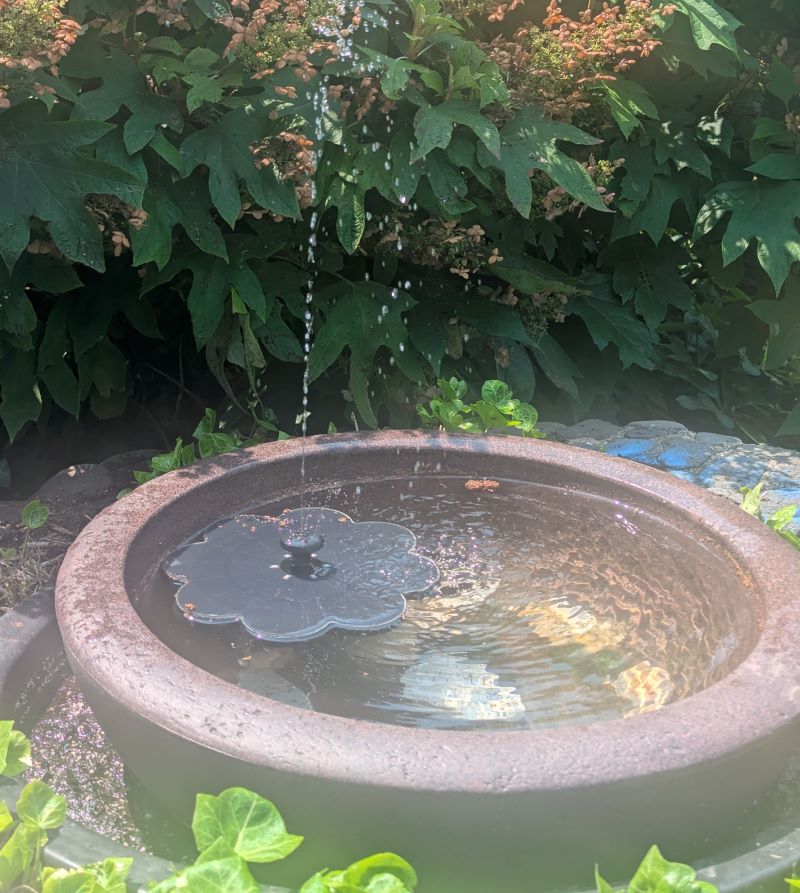
With the garden tour looming, we decided to make it into a water feature. Installing plumbing and wiring was not in the cards, so we decided on a solar-powered fountain. Fortunately these are inexpensive and easy to set up. We installed an old, overturned trash can in the well, topped it with a very large plant saucer, and set a basin atop that. The solar fountain, with its built-in solar battery went into the middle of the basin, which we filled up with water. Once the battery had a chance to soak up a few hours of sunshine, a spray of droplets shot up, enchanting my daughter, the local bird population, and me. The only regular maintenance needed was an occasional top-up of the water in the basin.
All went well for the first twelve hours.
The morning after we set up the water feature, we noticed that some creature had arrived in the night, knocked the basin askew, and broken one of the plastic stabilizer arms on the solar fixture. The colorful potted plants that we had arranged around the edge of the well had been swept to the ground. In assigning blame, we put our money on the two adolescent male deer that frequent our yard, figuring that they saw the water feature as a perfect drinking fountain. Antlers and aesthetic concepts don’t always mix well, and we decided that those antlers dislocated the basin, pushed away the potted plants, and damaged the stabilizer.
We cleaned up the mess, righted the basin, refloated the solar unit and topped off the water. The stabilizer was not integral to the unit’s operation, so the spray of water began once again. We repotted the toppled plants and relocated them. As an added disincentive to the bachelor deer, we sprayed the edge of the well with repellent.
The deer have persisted in making periodic forays to the fountain, but having simplified the display and invested in lots of repellent, we are able to have a sparkling spray most days.
Our second water feature is in an old galvanized washtub. The bottom has a layer of gravel, and we have positioned two water plants atop the gravel—a lotus and a variegated water garlic or Tulbaghia violacea. The water garlic was dirt cheap. The lotus was ridiculously expensive, which is why on the morning after we installed the two plants, we were appalled to find the water murky and the plants damaged. The lotus, which arrived with two hopeful leaves, was left leafless.
Our yard is home to at least two portly groundhogs that waddle around in a self-important manner and have little fear of humans. We fingered them for the havoc at the galvanized washtub. Like the deer, they had mistaken our lovely water feature for a drinking fountain.
We deposited the two plants in water-filled bowls, said prayers for the survival of the lotus, and cleaned out the galvanized washtub. The plants had been growing in mesh bags filled with aquatic compost. We ordered heavier, porous containers for them to keep the water cleaner in the event of groundhog incursions. We waited. When the new containers arrived, we repotted the water garlic, which had rebounded nicely, and the lotus, which evidently felt the power of our prayers and sprouted three new leaves. Both were installed in the galvanized tub. I took the extra precaution of surrounding the tub with potted specimens that animals generally don’t like—geraniums, coleus and perilla mint. This has apparently stymied the groundhogs, because the tub seems relatively undisturbed. We have high hopes that the lotus will reward our substantial financial commitment, as well as our prayers, by producing at least one flower in the next few weeks.
And so we have water features, which delight and inspire us—sometimes in ways that we could not have imagined. The catbirds that live in the trees on the property and supervise all gardening activities seem to approve. We have not consulted the deer or the groundhogs, but hope they understand. Our only worry now is the local raccoons, because we know they have spatial reasoning capabilities and mechanical skills beyond our own. For the moment, however, we feel gratified that we, like all of those English gardeners, enjoy our water features.