
 On days when I need a break, I take a neighborhood walk. On days when I need a really big break, I go farther afield, seeking out parks and natural areas within a reasonable distance of my home. One of my favorite parks winds around a large pond. The pond and its shoreline are s home to an array of birds, including cormorants, red-wing blackbirds, and the occasional great blue heron. It also contains a large number of plants. Familiar ornamentals grace the cultivated areas, but wild plants abound in the damp embankments edging the water and the swampy terrain at one end of the pond. Those plants offer doses of inspiration throughout the growing season.
In the spring, yellow, and occasionally, blue flag iris shoot up from the places where water and bank meet. The yellow species is a European import that has long established a foothold in North America. The blue flag is native. Both are beautiful, especially when the blooms are reflected in still water. Late spring and early summer is the best time to see the fragrant button bush or Cephalanthus occidentalis. Its round, buttonlike flowers exude an intense, sweetly spicy fragrance that draws people and pollinators. The six to 12 foot deciduous shrubs that bear the “buttons” are not otherwise memorable, but in flower they are irresistible.
Late summer finds the side of the pond abloom with tall ironweed or Vernonia gigantea, another native that soars between six and eight feet tall, with bright purple flowers whose petals appear to emerge from small thistles. The ironweeds are joined in the swampy areas by the white or pink flowers of swamp rose mallow, or Hibiscus moscheutos. Rising as high as the ironweeds, the rose mallows open their hollyhock-like flowers on sunny days, closing up when the sky clouds over. Each flower is short-lived, but the mature plants always boast many buds.
Early fall is the time for goldenrods and asters, especially white wood asters, with their thin petals and golden centers. People are likely to take both for granted, but for those of us who believe every flower is a miracle, they embody the spirit of fall.
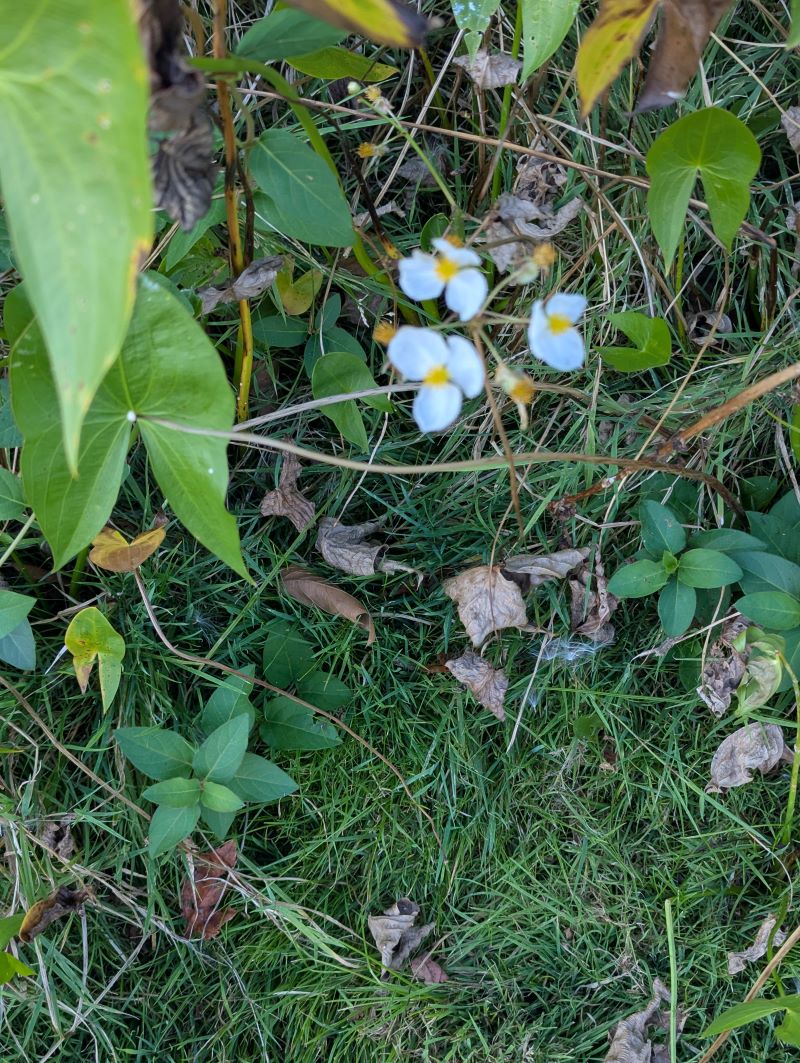
This year, the new miracle—at least from my perspective—was seeing broadleaf arrowhead in bloom. Known botanically as Sagitteria latifolia, it is a native perennial plant that at various times and places has also been known as “arrowhead”, “duck potato”, or even “wapotato”. The Latin generic name, sagitteria, describes the green leaves, which are shaped like arrowheads. Those arrowheads are up to 12 inches long, and are distinctive even when the plants are not in flower. Broadleaf arrowhead grows to a height of up to four feet from tubers that may be submerged in shallow water or growing in wet soil at the water’s edge. The names “duck potato” and “wapotato” stem from the fact that the starchy tubers have long provided food to beavers, muskrats and indigenous people. Ducks share space with the broadleaf arrowheads, but do not have the wherewithal to dig up the tubers. They may content themselves with eating the plant’s seeds.
In this part of the world, August through mid-September is flowering time for the broadleaf arrowhead, and the blooms are lovely. Rising from the water or water’s edge on stalks that are separate from leaf-bearing stems, the white flowers appear in whorls or groups of three. They look a little like tradescantia or spiderwort flowers, with three petals apiece surrounding either yellow or greenish yellow centers. Broadleaf arrowhead is prolific when the plants are happy, and the park where I see them is home to broad swathes of plants. At bloom time they make a beautiful statement.
I have never seen broadleaf arrowhead growing in a private garden, but if you have a water feature, damp area, or rain garden in a fairly sunny location, the plants might make a lovely addition. They naturalize readily.
The best place to buy seeds or plants is probably a garden center or online vendor that specializes in aquatic varieties. Install one in your garden and you will have the added pleasure of seeing garden visitors’ reactions to the words“duck potato”.