
 I love to walk—in my neighborhood, my town and wherever I vacation. I never wear headphones or talk on my phone, because I like to save my senses for the small worlds that I encounter on my way. Good suburbanite that I am, I always take stock of the neighbors’ gardens. But I am also fascinated by Nature’s landscaping. I like to see what grows in sidewalk cracks, neglected side yards and highway shoulders. Railroad rights-of-way may be home to loads of trash, but an amazing array of plants fight their way through that. In some seasons, those plants almost obliterate the refuse, fulfilling a biological imperative and doing a public service all at once.
The sides of the country roads near our family’s summer cottage are home to all kinds of plants. Some are common, including chicory, Queen Anne’s lace, black-eyed Susans and tawny daylilies. Others are great surprises. One summer I discovered a clump of blooming Gaura lindheimeri, known simply as “gaura” in the plant retail trade, or, more whimsically, by the common name, “Lindheimer’s beeblossom”.
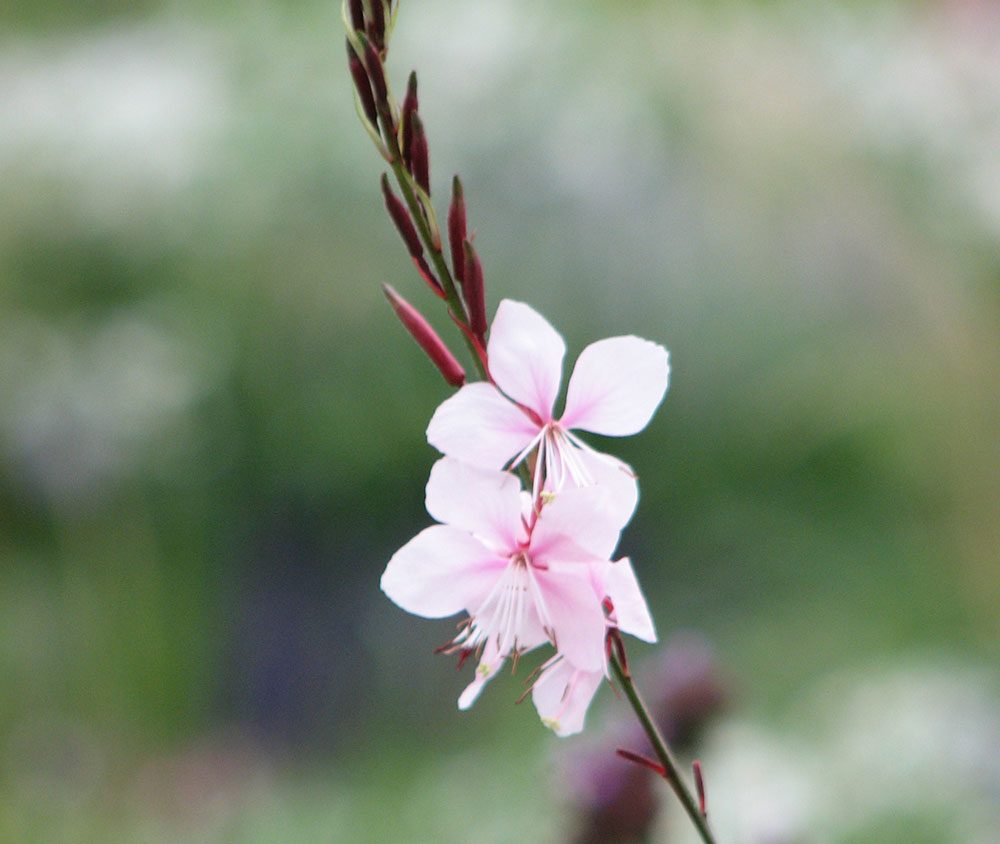
The roadside clump featured airy, delicate flower stalks that were about two feet tall and waved gracefully in the breeze. Narrow green leaves alternated on the slender stems and the top few inches of each stalk bore panicles of small, pinkish flowers. Like snapdragons, gaura flowers open sequentially, so every panicle was home to a combination of open blooms and unopened buds.
Gaura lindheimeri is an American native perennial and, hailing originally from Louisiana, Oklahoma and Texas. Given that, I suspect that the roadside gaura that I saw was another garden escapee. This fits with the textbook description of the species, which states that it naturalizes readily.
When I saw the gaura flourishing in the incredibly infertile confines of a road shoulder, I remembered that a nearby winery was celebrated for an eye-catching sustainable planting scheme highlighted by masses of pink-flowered gaura and purple lavender. Both plants are pollinator magnets, flourish in dry conditions and beautify the landscape over a long season.
Gaura is a prairies species, which means that it has a long taproot and doesn’t take well to being transplanted. Prairie soil is thin and free draining, so garden cultivation calls for soil that is well amended with fine gravel or sand. Heavy, moisture-retentive clay will encourage root rot. Soil that is too rich also fosters lots of leaf and stem growth, but fewer flowers. All that stem growth ultimately contributes to stem floppiness, which means either messy borders or staking—both frustrating to time-challenged gardeners.
To sum up, if you have a sunny spot with poor, dry soil, gaura will be the perfect ornamental plant for you.
The plant that I still call “gaura”—in company with most plant merchandisers—has recently been moved into the Oenothera genus, home to evening primroses and sundrops. The new botanical name is Oenothera lindheimeri. I believe the plant taxonomists do this just to keep the rest of us on our toes. To me, the delicate flowers will always say “gaura.”
So why is such a beautiful and useful plant stuck with an unwieldy species name like “lindheimeri”? As is often the case with plant names, “lindheimeri” harkens back to a person, specifically nineteenth century German immigrant, Ferdinand Lindheimer, who is also sometimes known as “the father of Texas botany.”
The university-educated Lindheimer emigrated from Europe in the early nineteenth century and eventually ended up in the German settlement of New Braunfels near San Antonio, Texas. He spent a large chunk of his working life as founding editor of the New Braunfels newspaper, but his passion was botany. He roamed over swathes of the Texas hill country and beyond, sometimes helped by members of indigenous tribes, gathering and preserving botanical specimens. His work is still celebrated in Texas. The larger botanical world remembers Lindheimer because some 20 plants include his last name in their Latin species names.
The gaura I found had smaller flowers than some of the cultivated varieties, which are available in shades of pink, white and red. One of the most popular cultivars is ‘Whirling Butterflies’, with white flowers and a three-foot tall growth habit. For something shorter, with darker flowers and foliage, try ‘Whiskers’ Deep Rose at 14 to 16 inches tall. Equally beautiful and just as small, ‘Little Janie,’ boasts white flowers tipped in pink. ‘Little Janie’ and other compact varieties, including the lovely variegated ‘Silver Fountain,’ may also work well in deep containers with free-draining soil.
In many places, there is still time to buy and install gaura before winter. You will thank yourself next spring. Try the selection at Bluestone Perennials, 7211 Middle Ridge Rd. Madison, OH 44057, www.bluestoneperennials.com.