
 In the middle of the twentieth century, the Brazilian actress and singer Carmen Miranda was a hit with the public. Known for her large personality, great talent, and fruit-bedecked headwear, she was celebrated for her “exotic” beauty. She was a trailblazer for Hispanic performers in the United States.
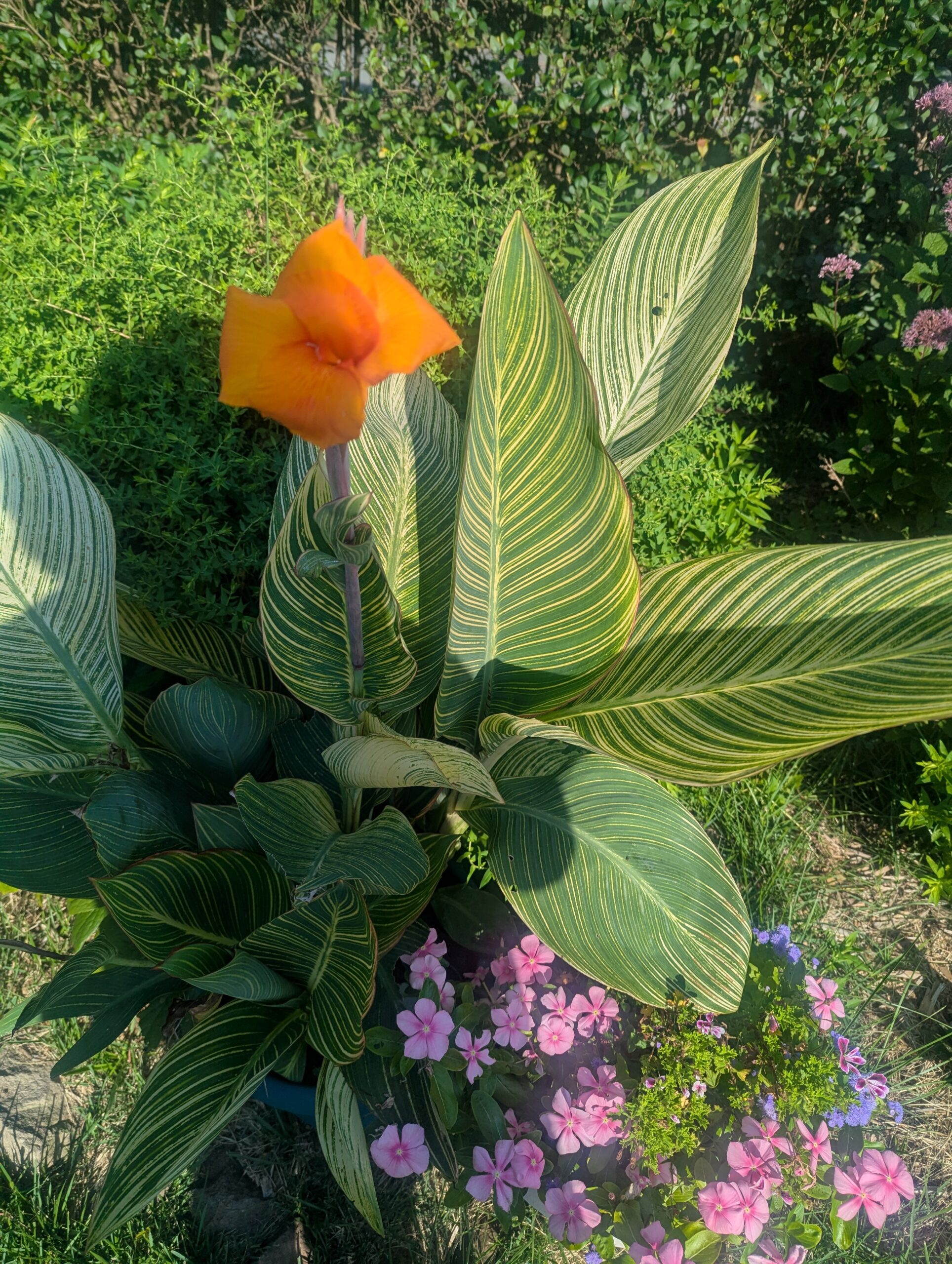
I think of Carmen Miranda when I look at the cannas in my garden. Like her they bring splashes of brightness to the spots where they perform in the beds. Native to tropical and sub-tropical climates in this country and into parts of South America, they are at once exotic and companionable with other garden plants. Dramatic foliage and bright flowers lift their surroundings. When it is hot and sticky and other plants are sulking, cannas hold forth brilliantly.
The canna posing seductively by your pool or patio has been popular for a long time. The plants were introduced in 1596, and first mentioned by American plantsman John Custis in 1735, well before American independence. By the Victorian era in the nineteenth century, the plants, sometimes known as “Indian shot plant,” “Indian frill,” and “arrow root,” were wildly popular, with many varieties available from nurseries. Denise Wiles Adams, in her wonderful book, Restoring American Gardens, mentions mouthwatering selections like ‘Roi Humbert’, which was described in the 1905 Wagner Park catalog with the words, “The flower is bright orange-scarlet, streaked with crimson. The foliage is bronze with brownish-green stripes, large, thick, and leathery.” Another catalog, from Storrs and Harrison of Ohio, describes ‘Florence Vaughn’, as being “The finest yellow spotted canna…color brilliant yellow, spotted with bright red.”
Cannas are rather singular, botanically speaking, belonging to their own genus, Cannaceae, which contains about 10 species and is most closely related to the tropical ginger family. Canna indica, native to Central and South America is a prominent parent of many hybrids, but modern cannas are the result of extensive crossbreeding. They are sometimes referred to as Canna x generalis. Growing from rhizomes, the plants can soar up to eight feet, though popular commercial varieties are generally less statuesque. The large, alternate leaves have been described as “paddle-shaped” and the flowers appear on spikes, reminding me a little of large gladiolas.
Cannas are all about saturated color, though if you want to err on the demure side of the garden spectrum, you can buy varieties like, ‘Ermine,’ which is cream-colored, or salmon-pink ‘Chinese Coral’. Otherwise, you can find varieties that are varying shades of scarlet, orange, yellow and pink, often adorned with contrasting speckles. Bi-colors, sometimes with contrasting petal edges, are widespread. The riot of colored flowers on each plant is enhanced by leaves that may be solid green, bronze to dark red, dark purple/black, or even striped. I am besotted with ‘Bengal Tiger’, which roars with orange flowers and leaves that are pin-striped in green and gold. For drama, it is hard to beat ‘Red Futurity’, with near-black leaves and brilliant red flowers on plants that reach four feet in height.
If you love cannas and have the space, you can grow the giants like Canna indica ‘Red Stripe’ that leaps up to eight feet. For those of us with smaller spaces, choices still abound. Canova ‘Gold Leopard’, with green foliage and golden petals speckled with red, reaches only three feet, perfect for containers or middle-of-the-border locations. ‘Striped Beauty’ is a double threat, with yellow flowers bearing white central stripes and striking leaves variegated in green and white on plants that grow between three and four feet tall.
For those of us who live in cold winter climates, cannas are not hardy, and the rhizomes should be lifted and stored in a cool dark place for the winter, with occasional misting to prevent drying. Replant outside when the soil is warm and sink the rhizomes to a depth of two or three inches. In marginal areas, like USDA plant hardiness zone 7, cannas can stay in the ground with a heavy—six inches at least—mulch over the plants.
Cannas like lots of sunshine and consistently moist soil. Producing big, flashy flowers and bountiful leaves requires nourishment, so feed regularly with an organic plant food applied according to the manufacturer’s instructions. You will not have to worry about applying deer repellant, as the leathery leaves are unappealing to those garden marauders.
Like Carmen Miranda, your cannas will attract lots of attention. Unlike her, cannas will get a lot of that attention from hummingbirds, which pollinate them. Butterflies are attracted as well.
Miranda’s musical genre was salsa. I think of cannas as salsa for the garden.