
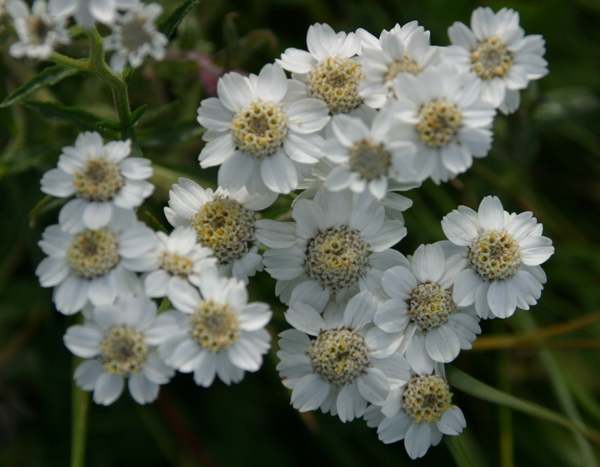
 It is late February, and the air is bone dry. That atmospheric condition will not last forever, and soon enough my part of the world will see a return of humidity. Eventually we will also experience hot weather. Now that the new season catalogs and online offerings are available, I am thinking of adding a selection of drought-tolerant plants to my garden. Among the loveliest are members of the genus achillea, sometimes also known as yarrow or “sneezewort”.
I have seen “wild” white yarrow along country roadsides in the summer and assumed that it was a native plant. Many older guidebooks make the same assumption, but yarrow actually arrived with the first European colonists and, like many of them, made itself thoroughly at home in North America. The generic name, “achillea” is an homage to the mythical warrior, Achilles, who allegedly made poultices of the aromatic leaves to staunch his warriors’ wounds. Those leaves have also featured in traditional remedies for abrasions and other wounds, not to mention toothache.
At different times and in different places, yarrow has also been known by a very large number of common names, including “milfoil,” ”wound-wort, “knight’s milfoil,” “stanchweed,” and “herba militaris.” It has also been credited with all kinds of magical properties related to divining love and attachment. These uses have fallen out of favor, as people have turned to the internet for divination, but the ornamental qualities of yarrow have found continuing favor.
All achilleas are members of the Asteraceae or daisy family, and the resemblance is occasionally noticeable in yarrows like Achillea lewisii ‘King Edward’, which features pale yellow daisies that resemble coreopsis flowers. Generally speaking, the resemblance between the majority of yarrows and daisies is only apparent to those who take the time to look closely at the congested, flattened flowerheads. Some species, like Achillea ptarmica and its hybrids, also feature small, pearl or button-like flowers that are quite undaisy-like.
The best-known yarrow is Achillea millefolium or common yarrow, which is native to northern Europe and western Asia. The plants are a bit gangly and can grow as tall as two or three feet, forming clumps that might be equally wide. Many cultivated varieties are smaller. The leaves are gray-green and so deeply dissected that they appear fernlike. While many of the yarrows on the market are the result of complex hybridizing efforts, millifolium fanciers can buy varieties like the sumptuous ‘Red Velvet’, which is closer to darkest rose than vermillion, but boasts flowerheads full of small, rosy daisies.
Some of the best yarrows are old faithful hybrids like the yellow-flowered ‘Moonshine’, developed by the English firm, Blooms of Bressingham, and the golden ‘Coronation Gold’. Dark red ‘Paprika’, another tried-and-true performer, glows in brick-red splendor. Newer hybrids abound, including pastel-flowered types like ‘Apricot Delight’ and pink ‘Sassy Summer Taffy’. Readily available bicolors include ‘Rainbow Tricolor,’ with large florets that combine shades of yellow, pink, and red. A little research online will yield yarrows in every color from bright white, through a range of creams, yellows, golds, pinks and reds. At the moment there are no blue yarrows, but with hybridizers stirring the genetic soup of the achillea clan and inserting genes from other genera, you never know what the future will hold.
I am very partial to the double-flowered ‘Angel’s Breath’, which is a great substitute for the gypsophila that I cannot grow in my acid soil.
Yarrows are amenable to container and small space growing as well. Woolly yarrow, also known as Achillea tomentosa is a mat-forming low-grower that tops out at six to 12 inches tall, with a potential spread of 18 inches. It is great for ground cover in smaller spaces, providing cheerful yellow flowers. ‘Ballerina’, a more compact form of ‘Angel’s Breath’ grows only 12 inches tall, with all the virtues of its larger relative.
Yarrows are perfect for sunny or very lightly shaded spots that experience summer dryness. As with most drought-tolerant plants, they must have good drainage, so amend heavy planting soil with sand, grit or other organic material. Cutting back the plants after flowering in early summer will often result in a second flush of bloom later on. Since the taller varieties may feature less-than-attractive “legs”, positioning yarrows behind lower growing species, like hardy geraniums, is a good idea. They will repay good positioning by being impervious to garden critters.
Yarrows are splendid in the garden and in long-lasting in arrangements, with sturdy flowerheads that also stand up to air drying for winter decorations. The colors will darken, but the charm will linger. Investing in yarrows—even if you don’t use them for divination–is really a four-season gift that you give to your garden and yourself.