
 I dragged my heels for at least ten days before putting away the holiday decorations. All the boxes went down to the basement before I realized that I had forgotten the outdoor bows, pinecones and other bright relics of the season just past. This was Freudian, I have no doubt.
Now the house is enveloped in January drabness, and that is depressing. It is also cold, gray and windy outside, a recipe for Seasonal Affective Disorder. I was wallowing in that the other day as I applied myself to my ancient Nordic Track machine in an effort to shift a few holiday pounds.
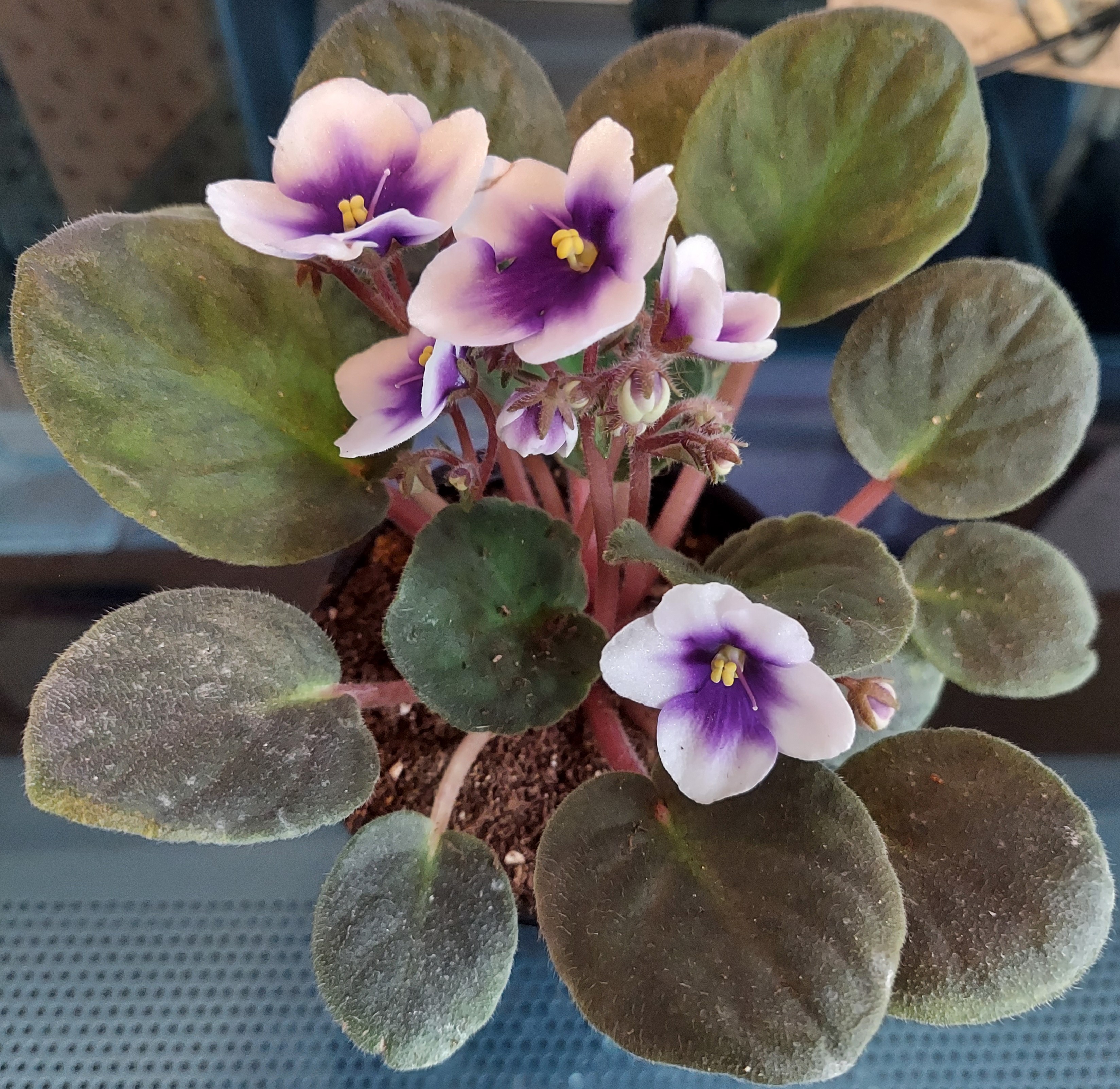
But salvation arrived in the form of a rather inane TV talk show that was airing as I exercised. I cannot remember the name of the guest or the topic of discussion, but I do remember that the low table in front of the host and guest was home to an impressive display of African violets in full bloom. The violets were in five large containers, with each container holding about three plants. The flowers sang out in a variety of purple and white shades. The whole effect was a perfect antidote to January drabness, and it made want to make tracks to the local garden center—or possibly the grocery store—to acquire some African violets.
This marks me as highly suggestable, which is true, but it also marks me as desperate for a little life and color in the house.
African violets are known botanically as Saintpaulia ionantha. The ancestors of modern hybrid varieties lived on the African continent, in mountainous regions of today’s Kenya and Tanzania. Though the flowers bear a superficial resemblance to those of members of the violet or Violaceae family, African violets are not related to them. They are gesneriads, belonging to the Generiaceae family along with other popular blooming houseplants, like streptocarpus and gloxinia.
Like many of their gesneriad relatives, African violets produce rosettes of evergreen leaves. Those leaves are rounded, somewhat fleshy, and covered with soft hairs. The flowers are borne on slender stalks and have five petals apiece—two upper petals and three, slightly larger lower ones. The petals may appear equal on many modern violet varieties. If you look at the flowers closely, you will notice that the petals’ bases fuse into a tube, another gesneriad characteristic.
In the nineteenth century, cradles of biodiversity in Africa, South America and Asia were rife with European colonizers, some of whom were keen amateur or even professional botanists. One such amateur was Prussian nobleman Walter von Saint Paul-Illaire, who, during the eighteen nineties, served as a bureaucrat for the German East Indian Company. Hiking through the Usambara mountains of eastern Tanzania, he discovered the low-growing plants that were eventually named in his honor. The baron sent seeds back to Europe and the saintpaulia craze began. It has not abated since.
If you decide that masses of African violets—or even a single plant—will bring cheer to your living space during the dark days of winter, it is comforting to know that they are so easy to grow, thriving in indoor situations where light is somewhat less than optimal. All you really need is a warm room, bright diffuse light and well-drained potting soil, as African violets dislike wet feet. Water only when the soil surface feels dry to the touch. Your plants will appreciate regular applications of commercial African violet food, applied according to manufacturers’ directions.
Of course, African violets are not the only available source of post-holiday cheer. Gloxinias, streptocarpus and primulinas can all do the same job with relatively little effort on the part of the indoor gardener. Kalanchoes, especially the lush Kalandiva varieties, are full of life and color. All are cheap, easy to grow, and likely to appear in all kinds of outlets, including garden centers, big-box stores and grocery stores. Mass as many as you can afford in places where you will see them regularly and enjoy the indoor show.
With cold winds breathing on the outdoor landscape, it is comforting to know that you don’t have to go out of your way to get yourself out of the seasonal slump.