 Every year I delight in going to the annual holiday display, “A Longwood Christmas,” at Longwood Gardens in Kennett Square, Pennsylvania. Longwood is one of the great botanical institutions of the world and the displays every year are magnificent. This year was a special treat because Longwood has opened its new East Conservatory, dedicated to Mediterranean and subtropical plants.
The holiday theme is present throughout the conservatory areas and extensive grounds, with every kind of plant material—from tiny succulents to towering palms—included in the holiday décor scheme. The theme this year was “jewels,” with trees and other exhibition plants growing out of containers that looked like giant jewel boxes, adorned with ornaments in jewel-like colors. It was spectacular.
The main conservatories were filled with familiar holiday plants, including poinsettias in every possible color, winterberry holly, paperwhites, and hundreds of amaryllis in an array of hues and petal configurations. Since plant fashion is also part of the Longwood experience, I always look for plants that seem to be riding the crest of the “in vogue” wave each year. This year the most modish specimens seem to be cybister amaryllis or Hippeastrum cybister.
Amaryllis has become a much-loved holiday plant, both in container and cut-flower arrangements. All amaryllis boast large, full-bellied bulbs that produce sturdy stalks topped by showy trumpet-shaped flowers. The stalks may be anywhere from 12 to 24 inches tall, depending on variety, with each one supporting four or sometimes five single or double flowers, their trumpets flairing out like the four points of the compass. The color range has expanded over the years, with red being the standard, but white, pink, apricot, yellow green, and bi-colored varieties are common.
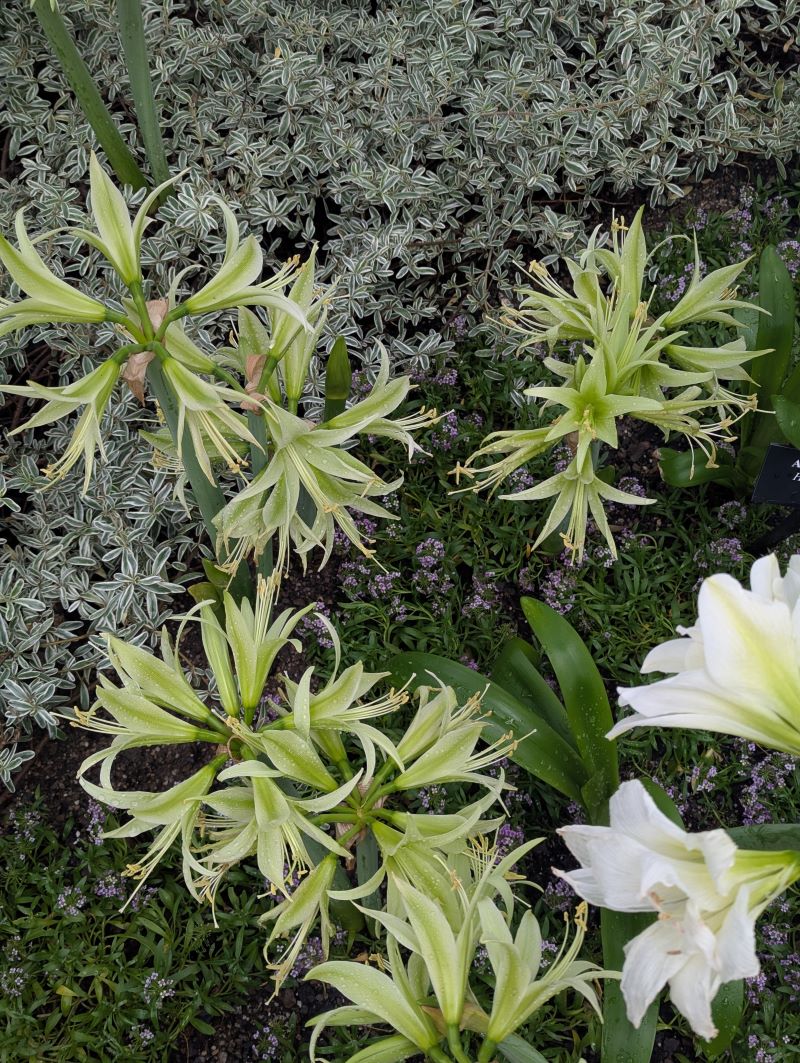
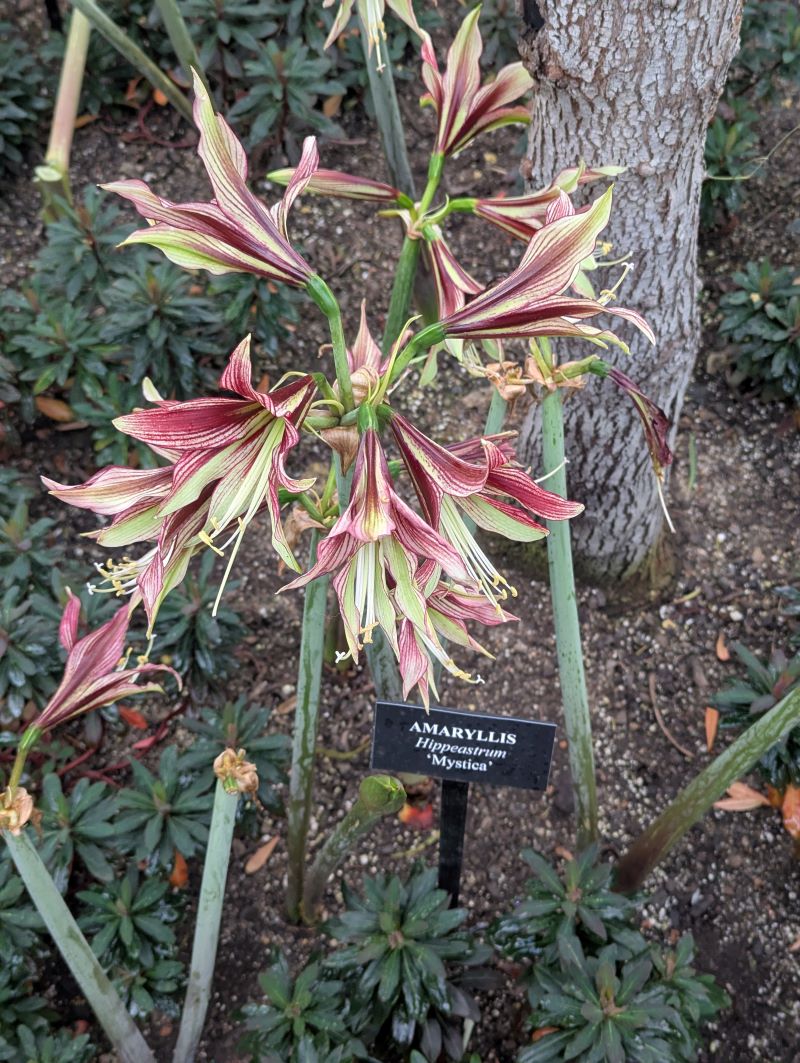
Cybisters are different from their amaryllis relatives because they embrace modish thinness. Instead of the fat petals of the traditional holiday amaryllis, cybisters boast a spider-like appearance, with slender petals, often in exotic colors, and/or bearing festive stripes. The strap-like leaves characteristic of all amaryllis are a little thinner as well. The effect is at once more delicate and wilder than traditional amaryllis.
I have noticed this vogue for thin petals in other species as well. Looking through the daylily catalog listings, I have seen more spider types in the past few years. Spiders of all kinds are clearly having a moment.
As the popularity of the hippeastrum clan has accelerated over the decades, so has amaryllis breeding. The species, Hippeastrum cybister, ancestor of today’s plants, originated in South America, specifically in areas of Brazil, Bolivia and Argentina. In the palmy 1970’s, when disco and a number of questionable fashions held sway, breeders, including San Diego’s Fred Meyer, started producing new and different cybisters. The cherry-red and white striped ‘Ruby Meyer’, undoubtedly named for one of Meyer’s female relatives, was typical of the new arrivals.
Now, a number of cybisters dot the marketplace. I saw two of them at Longwood. ‘Mystica’ combines slender lime green petals with dark red stripes, living up to its name. ‘Evergreen,’ another popular variety, forsakes the stripes in favor of solid lime green petals that darken towards the heart of each flower. Both lent exotic touches to the opulent holiday displays.
Fortunately for home gardeners, cybisters are as easy to grow as other amaryllis. When you purchase them, the fat bulbs already have everything they need to produce blooms in the first year. Place them, pointy ends up, in soil, but only cover about halfway up the bulb. Water when the top of the soil feels dry, as the plant sets roots. You can also grow the fresh bulbs in a saucer or tray of pebbles and water, with the bulbs sitting atop the pebbles.
I keep my holiday amaryllis from year to year and treat them like ordinary houseplants. After flowering, allow the long leaves to develop without interference, watering sparingly as necessary. If you can, place the containers of amaryllis outside in a sunny spot during the growing season. If not, position them inside in a location where they will receive bright light. Continue to water when the soil surface feels dry and fertilize once a month during the growing season to prepare the bulbs for repeat flowering. I have had great success with reflowering amaryllis, though the blooms do not usually occur at Thanksgiving or Christmas. I think that makes them all the more welcome at other times.