
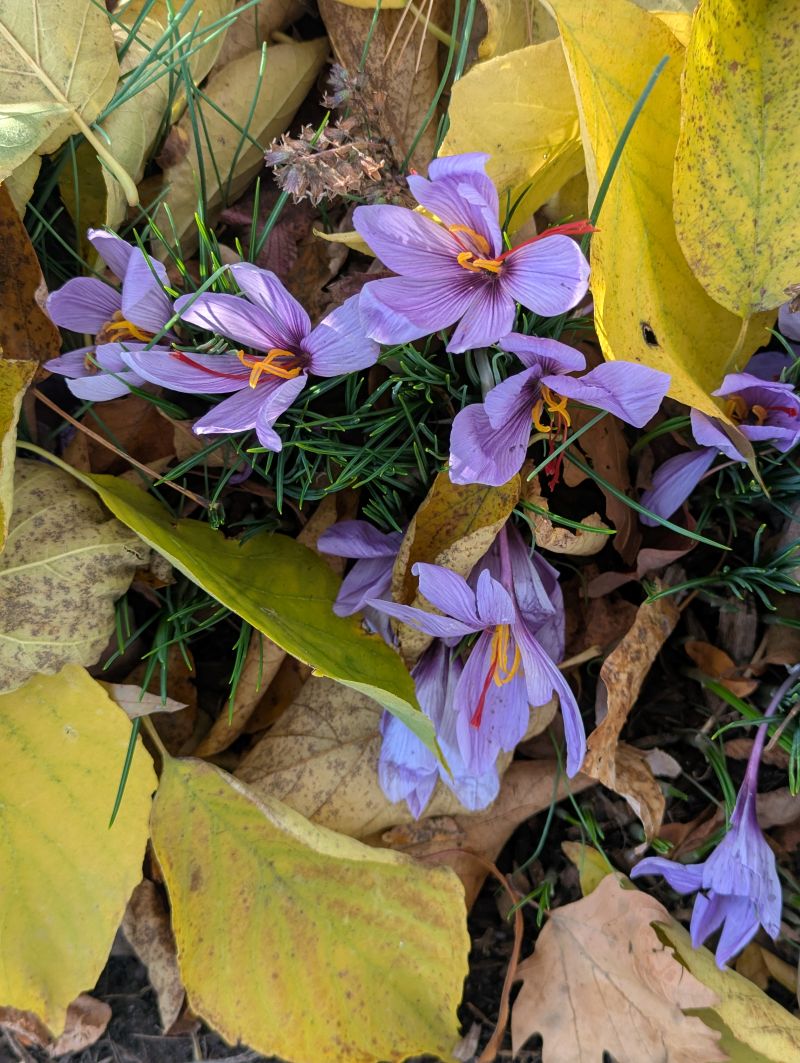
 In spring and fall, when the garden is either just waking up or going about the business of the fall shutdown, small flowers are easier to notice. The other day I was stopped dead in my tracks by a clump of saffron crocus or Crocus sativus. The clump has been in the same place, under the silverbell tree, for years, but the blooms had only just opened, and the wind had swept away the leaf accumulation. Suddenly, the fall light hit the purple blooms in just the right way and it was impossible not to see them.
At three to six inches tall, saffron crocuses look much like their spring counterparts, except for petals that shine in a slightly more brilliant shade of lavender-purple, with prominent veins in darker shades. Their most prominent feature is also the aspect that has made them celebrated by both cooks and gardeners. Each bloom produces several long, prominent golden-orange stigmas atop the styles at the center of the flower. Those stigmas are the source of culinary saffron, long prized in many cuisines for its ability to lend distinctive flavor and color to a range of dishes.
It takes a lot of stigmas to produce even small amounts of saffron—one source estimates that producing one pound of saffron requires the stigmas of 75,000 crocuses. A check of online retail listings reveals that 0.1 ounce of saffron costs about $22.00. Clearly the little crocuses are also little gold mines, especially in Spain and Iran, which produce most of the world’s supplies. I can only imagine the radiance of the saffron fields when the flowers are in full bloom.
I do not harvest the stigmas from my crocuses, but I appreciate their beauty. The flowers are sensitive to light, awakening and opening in the mornings and closing at night and on cloudy or rainy days. In my garden, bloom time is usually in late October or earliest November, depending on weather conditions. The loveliness lasts for up to a week, with cooler temperatures supporting longer bloom times.
Most spring-blooming crocuses produce leaves after they bloom, with the elongated flower buds emerging first from the cold ground like little signs of hope. Saffron crocus leaves, which are narrow and grass-like, appear just before the flower buds.
Like all small flowers, saffron crocuses should be planted in sites where they can be seen to advantage, including the fronts of beds and borders, in rock gardens, or along pathways. They can also be grown successfully in containers and work well in situations where spring and summer flowering annuals can provide color prior to the fall emergence of the crocuses.
Planting in grass also works, as long as mowing is either finished for the season or curtailed during the blooming period. Leaves should be swept or blown away from the areas where the bulbs are planted so that the flowers aren’t submerged under layers of fallen foliage.
Squirrels, whose labors turn frantic in fall, are perpetual nemeses for gardeners, but especially for those of us who grow plants that sprout from bulbs. While your resident squirrels may or may not eat the saffron crocus bulbs after early fall planting, they will often dig them up. To prevent this, I spray the bulbs with deer repellent before they go into the ground, then spray the soil atop the newly planted area. I also cover the area with chopped lavender or perilla mint stems, both of which have aromas reputedly disliked by deer and rodents. Once the flowers are blooming, I have found that squirrels are uninterested.
Just as 60 is reputedly “the new 40” with regard to human aging, so fall is reputedly the new spring when it comes to gardening. Fall-blooming crocuses, including Crocus sativus, abound in the catalogs and online offerings, but are considerably less popular than the spring-flowering varieties. I chalk this up to a shortage of positive PR, as well as the weariness of gardeners in the late summer when fall-blooming crocuses are generally marketed.
If you already grow saffron crocus and it has finished blooming, you can lift and divide the bulbs now to increase supplies. If not, make a note to order some next August. I cannot guarantee that their presence in your garden will delay the onset of Seasonal Affective Disorder, but they will certainly add a bit of brightness.