
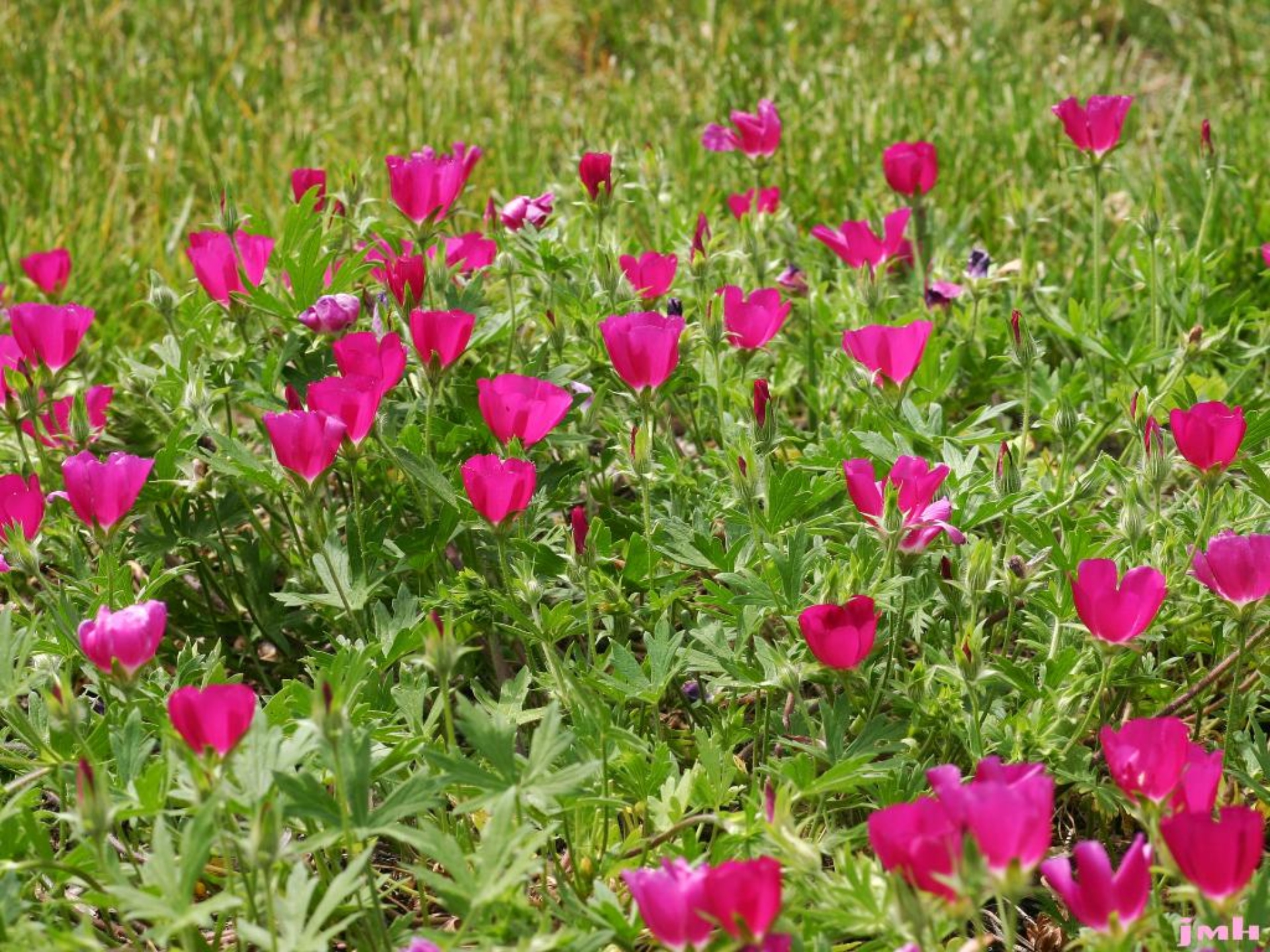
 Right now the soil in my garden is dry as dust, despite rain late last week. I generally do not irrigate, but it is time for the sprinkler to come out. Watering the containerized plants continues as a matter of course. In addition to combating the dry situation, I am feeling grateful for the plants in my garden that do not need extra water because they sink deep taproots and do best in dry or drought conditions. A recent addition, perennial purple poppy mallow, or Callirhoe involucrata, is one of them.
Like other showy plants already at home in the garden, including rose of Sharon, hibiscus, and hollyhock, poppy mallow is a member of the Malvaceae or hollyhock family. Like other mallows, its blooms feature five petals joined at the base of each flower and a prominent central staminoid column. The flower color is an eye-catching magenta. Where poppy mallow differs from some of its relatives is in its deeply dissected leaves, which bear a greater resemblance to those of some hardy geraniums, than to the lobed leaves of the mallows.
I was not familiar with purple poppy mallow until I saw one on a recent garden center visit. As is often the case with plants these days, this native plant has benefitted from a concerted marketing effort. The tag read “Caterpillar Candy®” in letters that were larger than those for the common name of the plant. The Latin name was relegated to the back of the tag. Clearly an effort to attract the burgeoning number of gardeners with butterfly or pollinator beds and containers.
A little research revealed that “Caterpillar Candy’ is a one of the trademarked brands of a family-owned firm, Centerton Nursery, based in Bridgeton, New Jersey. Now run by third generation members of the Blew family, the firm raises plants and sells to local garden centers. If you have ever bought plants with any variation of the Blew name, like BlewLabel®, you have purchased a Centerton plant. All the Blew family’s offerings are sold in signature bright blue pots. Other trademarked Centerton names include Autumn Additions® and Bring Back the Butterflies®.
In keeping with the firm’s apparent commitment to sustainability, pollinator gardening, ease of cultivation, and promotion of native plants, purple poppy mallow is native to dry parts of the central United States. It is a mounding, low-grower, topping out at about 12 inches, with a spread of up to three feet. This makes it comfortable wending its way along the ground, with its magenta flowers popping out at regular intervals. It might also be grown by stone walls and allowed to sprawl alluringly over the sides.
As with other members of the Caterpillar Candy® line, like butterfly weed, Dutchman’s pipe, and wild lupine, butterfly-related information is listed prominently on the plant tag. In the case of purple poppy mallow, the butterfly attracted to the plants is the checkered skipper, which has a dark brown or black and white checkerboard pattern on its wings and a hirsute gray body. Skippers are a bit like a butterfly/moth cross, with butterfly-like wings and moth-like bodies. The checkered skipper uses malva family members, including purple poppy mallow, as both larval and food plants. I am hoping that the inclusion of my newest mallow will encourage these eye-catching skippers to visit my garden, joining their relatives the silver-spotted skippers among the blooms.
To keep the purple poppy mallow happy enough to entice those skippers and other butterflies that may be trolling the neighborhood in search of nectar, plant in well-drained soil in a sunny spot. Like most drought-tolerant species, these mallows despise wet feet. My soil is water-retentive clay interspersed with rocks. While those rocks may provide a modicum of drainage, I replaced them with organic material and a bit of sand when I filled in the planting hole. With luck that will be enough to persuade the purple poppy mallow to sink its roots into my garden.
I am not a native plant purist, but do try to include a number of natives, like New England asters, goldenrod, butterfly weed, and oakleaf hydrangea in the beds. This summer and fall, they have all behaved like champs, despite the long, cold, wet spring, and subsequent late summer and early fall dryness. That experience gives me high hopes for this newest mallow.