
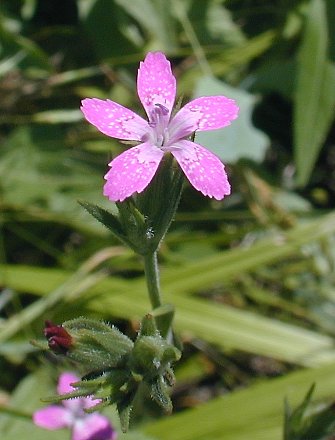
 As ornamental plants go, Deptford pink or Dianthus armeria, also sometimes known as grass pink or mountain pink, rates somewhere on the showiness scale alongside snowdrops. The flowers are about half an inch wide, on slender stems that max out at 12 inches, but are often shorter. To add to this picture of general inconspicuousness, the leaves are grass-like and probably would not be noticed at all when the plants are not in bloom.
With all of those attributes, Deptford pink, a biennial or short-lived perennial, might easily be forgotten, if it were not for one very important trait—flashy, bright pink flowers, sometimes with attractive speckles. When the plants bloom, usually in very late spring or early summer, depending on climate and location, the flowers are like little sparklers—bright dots in the landscape. Each one has only five petals, and those petals have ragged edges, appearing as if they were clipped with pinking shears.
I have never seen a Deptford pink in a garden, but the little flowers often appear on the edges of fields, in untended stretches between street and sidewalk, and at the sunny areas surrounding wooded plots. In those situations they are like sweet surprises. It is hard to get close enough to smell the flowers, because you would have to get down on your knees, with our nose almost at ground level, but they are reputed to have some scent, and are an attraction for pollinators. Small pollinators would probably have the best luck, as an average bumblebee landing on one of the petals might overbalance and fall right off.
Still, Deptford pinks are card-carrying members of the dianthus genus, home to such lovelies as carnations and sweet Williams. All told there are 300 or more species, native to Europe, Asia, and elsewhere. Dianthus, in turn is part of the even larger Caryophyllaceae family, which also includes gypsophyla, a longtime florists’ favorite.
But where is “home” for Deptford pinks? Not surprising they have long grown around the town of Deptford, once a small town, and now a part of southeast London, along the Thames River. At some point in time—probably during the Colonial era–they crossed the Atlantic and took up residence inn North America. Like many immigrants, they thrived in the new environment and made themselves at home in many places. Some, who don’t know their origins, would put them in the wildflower category.
Sadly, Deptford pinks are a rarity now in their native regions due to urbanization, industrialization and habitat loss. European specimens are doing a bit better. Fortunately they are so prolific here that there are those who even call them invasive. I have never seen enough of them in one place to use the term, though I suppose that at some times and in some places, they might be in competition with native plants like Sisyrinchium or blue-eyed grass.
Like many members of the dianthus clan, Deptford pinks have been used in traditional herbal medicine, treating various ailments, including digestive complaints. These days it is easier to solve those problems with an over-the-counter remedy and enjoy the pinks as ornamental plants.
The little plants enjoy sunshine and well-drained soil, disdaining perpetually wet roots. Buying starter or full-grown plants seems to be unusual, but online and catalog vendors offer seeds for sale. The seeds seem to require cold stratification, which means that once planted, they need to experience cold winter temperatures in order to germinate. Planting the seeds now would probably mean that they would not come up until next spring, which is fine, considering their bloom time. Once established, Deptford pinks are happy self-seeders and will take care of propagation on their own.
If you are interested in growing these small gems in your garden, you can obtain seeds from Everwilde Farms, 560 Industrial Way, Fallbrook CA 92028; (888) 848-3837; http://everwilde.com.