
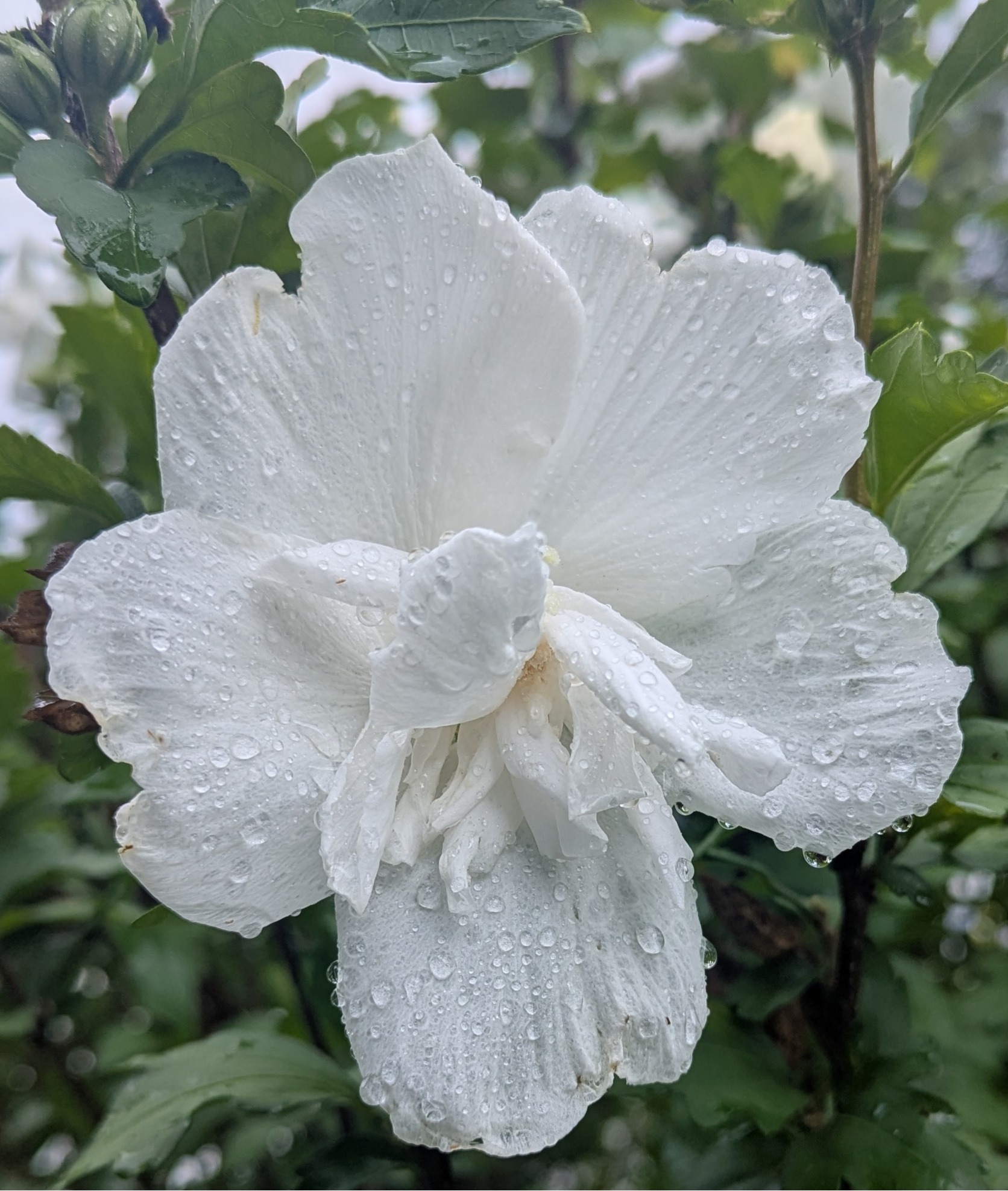
 In the suburban gardens near my house, I hardly ever see common hollyhocks or Alcea rosea. Maybe they are considered too old-fashioned, rough-looking, or unruly. It might be because they grow so tall that they sometimes need staking. It’s equally possible that they have suffered the same fate that afflicted dahlias until a decade or so ago—a reputation for being too obvious and gaudy. Now dahlias are fashionable, but back then, having one in the front garden was the equivalent of posting a sign proclaiming the slogan, “Proudly Lower Middle Class.” Such ideas are anathema in suburbia. It would be sad if the same thing currently holds true for hollyhocks.
I love hollyhocks because they are so colorful and welcoming, with outward facing flowers in cheerful colors. That love was reaffirmed last week as I drove around rural Central New York State on vacation. Houses and farms featured hollyhocks in garden beds and by mailboxes. They bloomed in great profusion near barns. People in small towns kept masses of the tall plants near front doors. I was so inspired that I bought two large double hollyhocks at a local farmstand. I thought at first they were varieties of ‘Chater’s Doubles’, an Alcea rosea variety first introduced in the late nineteenth century. However, ‘Chater’s Doubles’ have the rounded leaves of Alcea rosea, and my new beauties bear fig-like leaves, marking them as members of the Alcea ficifolia or figleaf hollyhock species. The flowers are similar, but ficifolia varieties sport leaves that are more finely dissected than those of the common hollyhock.
Now those figleaf specimens are in my home plant holding area, awaiting a prominent place in my garden.
Alcea rosea and Alcea ficifolia are biennials or short-lived perennials that rank among about 50 Alcea species. They are unmistakable, with tall, hirsute stalks and round flowers that bear characteristic prominent yellow or cream staminal columns in the centers. The flowers, which bloom at the tops of the stalks, are three to four inches across with petals that remind me of crepe paper. They don’t last long on the plants, but the fat, teardrop-shaped buds open in succession over a number of days for continuous bloom. Single-flowered varieties come in many shades of red, pink, cream and pale yellow, some with contrasting eye zones in the middle of each flower. Doubles like mine are fluffy and might remind you of the tissue flowers that some of us made to decorate high school proms and other adolescent social events.
I first met hollyhocks as a child in my father’s garden. The tall stalks sprouted at random by the sandbox and bloomed with abundant pale pink flowers. No one planted the first hollyhock, so it probably originated as the result of random bird or animal landscaping. Eventually, when the seedpods dried and split open, I helped nature along by planting the little bulls-eye seeds.
What’s not to like about the common hollyhock, or its slightly less common relative, the figleaf hollyhock? The stalks, which can grow up to six feet, are gangly. This can be easily remedied by planting shorter perennials or annuals in front of them. A riot of snapdragons can go a long way towards disguising less-than-attractive plant “legs”. Hollyhocks also suffer from rust, a fungal disease that shows up as rusty brown patches on leaves. Infection happens when leaves are wet, and warm humid conditions favor its growth and spread. To combat rust, make sure plants have good air circulation and avoid splashing leaves when you water. If you see rust on the hollyhock leaves, remove any affected foliage and discard it. A little vigilance goes a long way towards the goal of attractive hollyhocks.
Growing hollyhocks from seed is easy, and vendors offer many varieties in the spring. You can also buy young plants in spring and summer at garden centers. Some seed-grown strains are biennial, so basal leaf rosettes will form the first year after planting and flowers will follow the second year. Others are short-lived perennials, which will return for several years and then die. Check seed packets and plant labels for the specifics. Fortunately most varieties produce abundant seed and have a self-seeding tendency, making the plants effectively perennial.
Plant those seeds or young specimens in loamy, well-drained soil in full sun, and water until they establish roots. In my experience, hollyhocks can tolerate some drought, but prefer more consistent moisture.
If you have friends or neighbors with hollyhocks, see if you can collect some seeds. Store them in the refrigerator until early next spring and start them indoors, or wait and sow them directly in garden beds or large containers. Several online and catalog vendors carry ‘Old Barnyard Mix’, a collection of traditional single hollyhocks in a variety of colors. They light up summer gardens in a way that will make you want to defy suburban convention.