
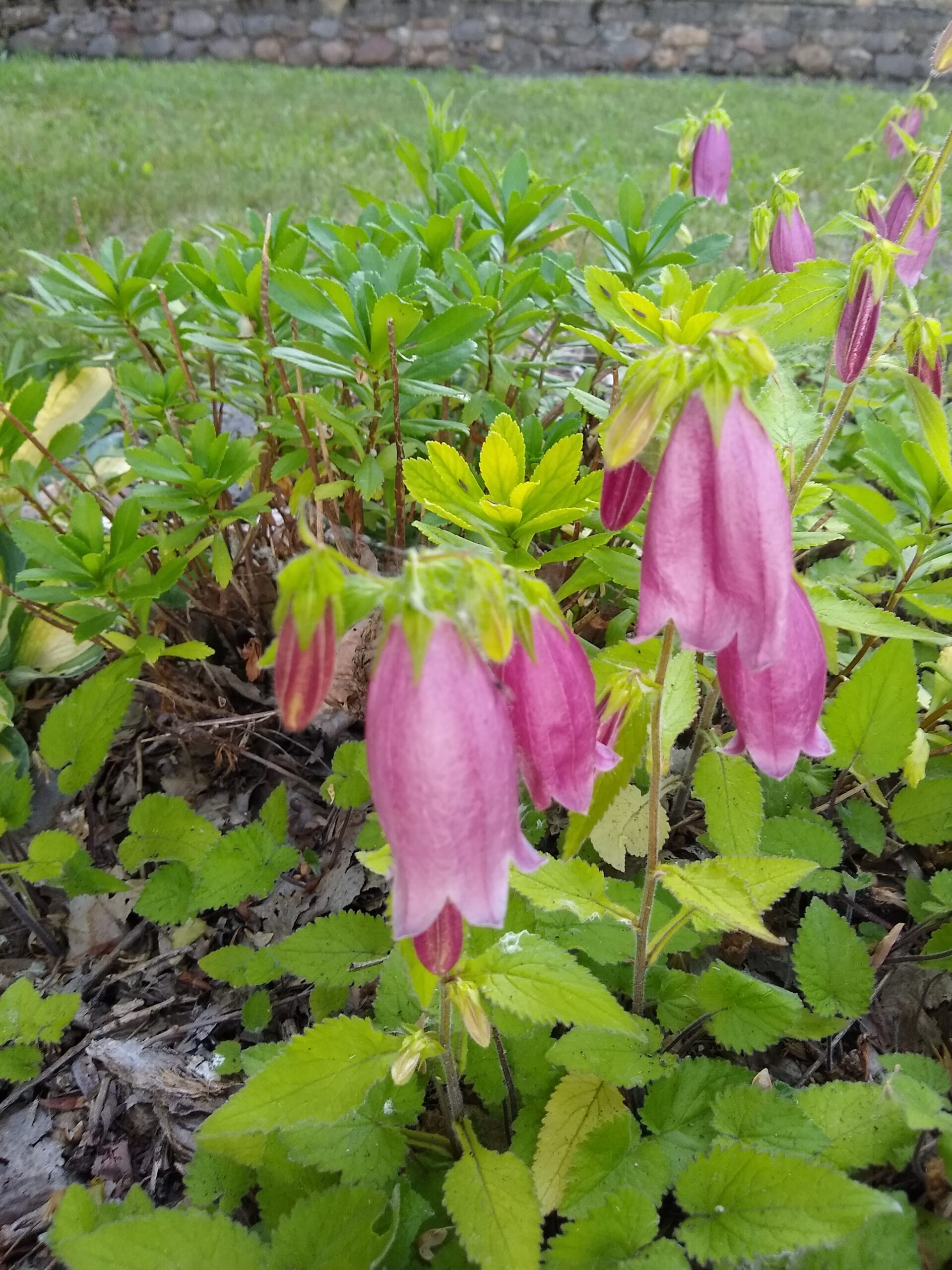
 I am about to leave for vacation at my family’s summer cottage in Central New York State. Over the years I have developed several garden beds on the property. Even though I only see and tend them for brief periods each year, they hold a special place in my horticultural heart.
Ten ago I bought an alluring plant from a roadside stand near the cottage. The “stand” was actually a large cart, laden with perennials that were clearly surplus specimens from someone’s well-stocked garden. The “someone” was nowhere to be seen. Among the offerings were gaillardia daisies, Shastas, catmint, and my choice, which was simply labeled “bellflower”. The single nodding “bell” that adorned my plant was about two inches long and dusty pink, with a narrow, lighter pink rim on the edge. The price was two dollars, which I deposited in the honor box at the end of the cart, before moving on. When I arrived back at our summer cottage, I planted my bellflower in a little bed that surrounds a large cottonwood stump.
Any plant that survives at the cottage—and many do—must make do on its own. The soil ranges from heavy clay at the top of the embankment that bounds our driveway, to shale beach by our dock. The tree stump bed is somewhere in between those two extremes. When I planted the bellflower on the sunnier side of the round bed, it joined several hostas and an array of other sturdy perennials.
For some reason, I didn’t do any research on the new acquisition after I planted it. By the spring of the following year, the single bellflower had morphed into three plants. By summer those plants had sprouted a bevy of long, ridged buds and additional pink bells. Clearly they were thriving without help in the deer-populated, USDA Zone 5 climate. That alone was worthy of further investigation.
My research led to the proper Latin name of those bellflowers, Campanula punctata, or even more formally, Campanula punctata f. rubriflora. This is loosely translated as “spotted bellflower with pink blossoms”. The plant’s admirers just call it “spotted bellflower”, or sometimes, “long-flowered bellflower”. The species is part of the very large Campanulaceae or harebell family, which includes about 2400 species, growing on every continent except Antarctica. Spotted bellflowers hail from Japan and Siberia, and most likely arrived here in the eighteenth or possibly nineteenth century. The plants grow one to two feet tall, rising from mats of toothed foliage. Ridged, capsule-shaped buds open into pendant, lantern-like flowers that may be up to three inches long. Each blossom is also broadly toothed at the bottom. Because the flowers hang from the stems, it takes effort to look inside them. If you take the trouble, you will get the bumblebees’ eye view and see the purple spots that gave rise to both Latin and common names.
Because of the bellflowers’ vigor, I suspect that they have long been popular “pass along” plants—the kind that you acquire from avid gardening friends, or the occasional roadside stand. I suspect that my plant is probably ‘Cherry Bells’, which seems to be the most common. Breeders have not latched on to Campanula punctata as they have with some other species, so you will not find scores of spotted bellflower varieties on the market. The Chicago Botanical Garden did a large-scale campanula evaluation in 2008 and listed nine different forms and varieties. Those with flowers in shades of dark pink and pink-purple predominate, including ‘Cherry Bells’, ‘Bowl of Cherries’ and ‘Vienna Festival’. ‘Alina’s Double’ is in the same color range, but with double bells, configured one inside the other in an arrangement that an older generation of English and American gardeners would call “hose in hose”. White Campanula punctata f. albiflora has also given rise to a cultivated variety called ‘Wedding Bells’. All forms and varieties are characterized as “spreading”.
Since the spotted bellflowers in the New York State garden seem to be bent on world domination, I am going to separate a clump and replant it in one of my beds at home. Deer, which are a problem in my neighborhood, allegedly do not like them.
At this time of year, some local garden centers may carry spotted bellflower. Plants are also available from various Etsy shops online. If you want ‘Cherry Bells’ to fill those blank spaces in the garden, you can get it from Digging Dog Nursery, 31101 Middle Ridge Road, Albion, CA 95410; (707) 937-1130; www.diggingdog.com. Other varieties are harder to find, but one nursery, Brandywine Cottage, offers ‘Silver Bells’, a pale pink variety. Find them at Cavano’s Perennials, Inc., PO Box 248, Kingsville MD 21087; (410) 592-8077; www.brandywinecottage.shop. Digging Dog also offers a print catalog.